Spain’s house price rises decelerating, but outlook remains upbeat
Spanish house prices are still setting records, but the engine driving them has changed. Buying activity has fallen for two consecutive quarters, the European Central Bank has begun raising interest rates for the first time since 2023, and construction has finally accelerated to its fastest first-quarter pace since the 2008 crash. Prices are rising into a market that is buying less, borrowing at higher cost, and building more.
This extended overview from Global Property Guide covers key aspects of the Spanish housing market and takes a closer look at its most recent developments and long-term trends.
All euro conversions in this report use a single reference pair, EUR 1 = USD 1.1583, the market close on 28 August 2026.
Table of Contents
- Property Prices and Price Index
- House Price Variations
- Historic Perspective
- Property Demand Trends
- Property Supply Trends
- Rental Market: Rents and Rental Yields
- Mortgage Market and Interest Rates
- Economic and Social Factors
Property Prices and Price Index
According to the National Statistics Institute (INE), the transaction-based House Price Index rose by 12.9% year-on-year in Q1 2026, unchanged from the rate recorded in Q4 2025 and the fourth consecutive quarter at or above 12.7%. Prices have now grown at double-digit rates for six straight quarters.
Spain's house price annual change:
The stability of the headline figure conceals a widening split between the two halves of the market. Second-hand housing accelerated to 13.5%, a further 0.4 percentage points above the previous quarter, while new-build prices decelerated by 2.1 percentage points to 9.1%. The gap between the two segments has opened to 4.4 percentage points, and it runs in the opposite direction to the one reported a year ago, when new construction was the faster-rising segment. Resale stock is now doing almost all the work.
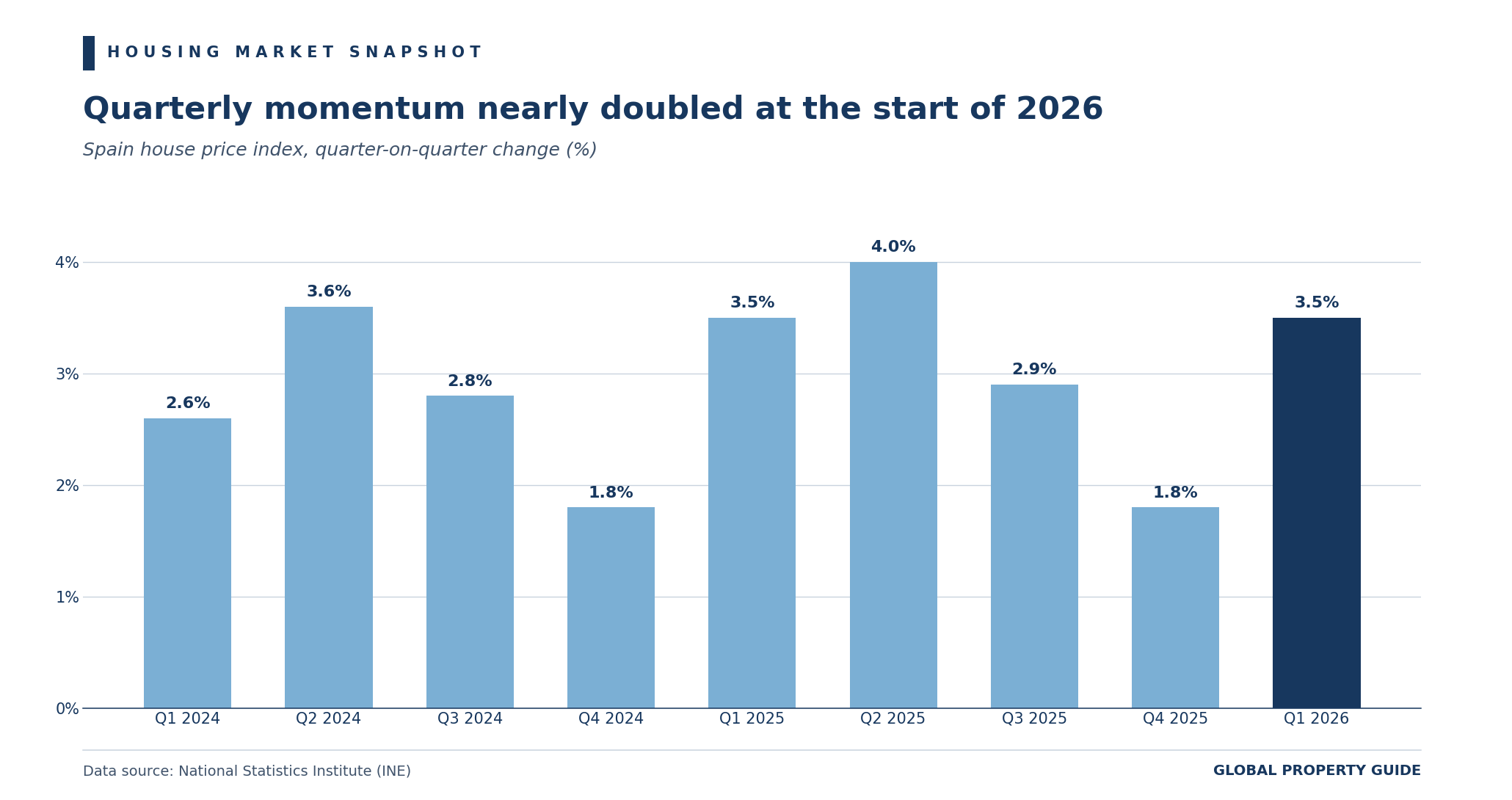
Quarterly momentum also picked up sharply. Prices rose 3.5% in Q1 2026 alone, nearly double the 1.8% recorded in the final quarter of 2025, with new and second-hand housing both advancing 3.5% over the three months.
Two methodological changes affect how this quarter's figures should be read. From Q1 2026, the INE rebased the index from 2015 to 2025 and updated the regression model behind it, adding a variable that distinguishes whether the buyer is European and whether the property sits in a tourist province. The institute states that neither the rebasing nor the reweighting altered the published rates of change, since the index is chained, so the growth figures above remain comparable with earlier editions.
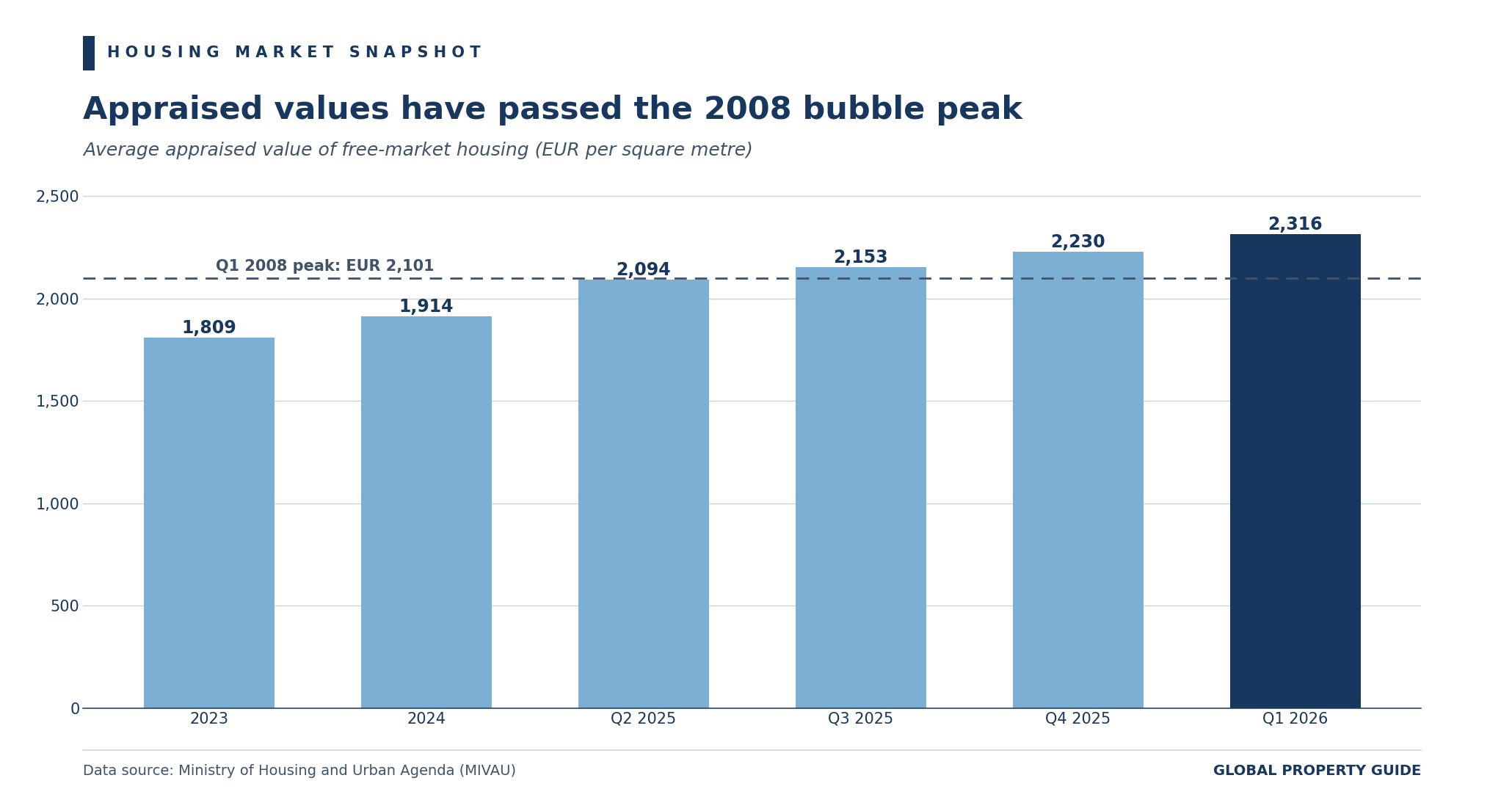
In the appraisal-based series, the average value of free-market housing reported by the Ministry of Housing and Urban Agenda (MIVAU) reached EUR 2,315.7 per square metre (USD 2,682) in Q1 2026, up 13.9% year-on-year and 3.8% over the quarter. It is the highest level in a series that begins in 1995, the fifth consecutive quarter above EUR 2,000, and roughly 10% above the EUR 2,101 peak reached at the height of the 2008 bubble.
House Price Variations
Every region is now in double digits
Price growth in Q1 2026 was positive in all seventeen autonomous communities and both autonomous cities, and for the first time in this cycle every one of them recorded a double-digit annual rate. The spread between the fastest and slowest regions has narrowed to 5.3 percentage points.
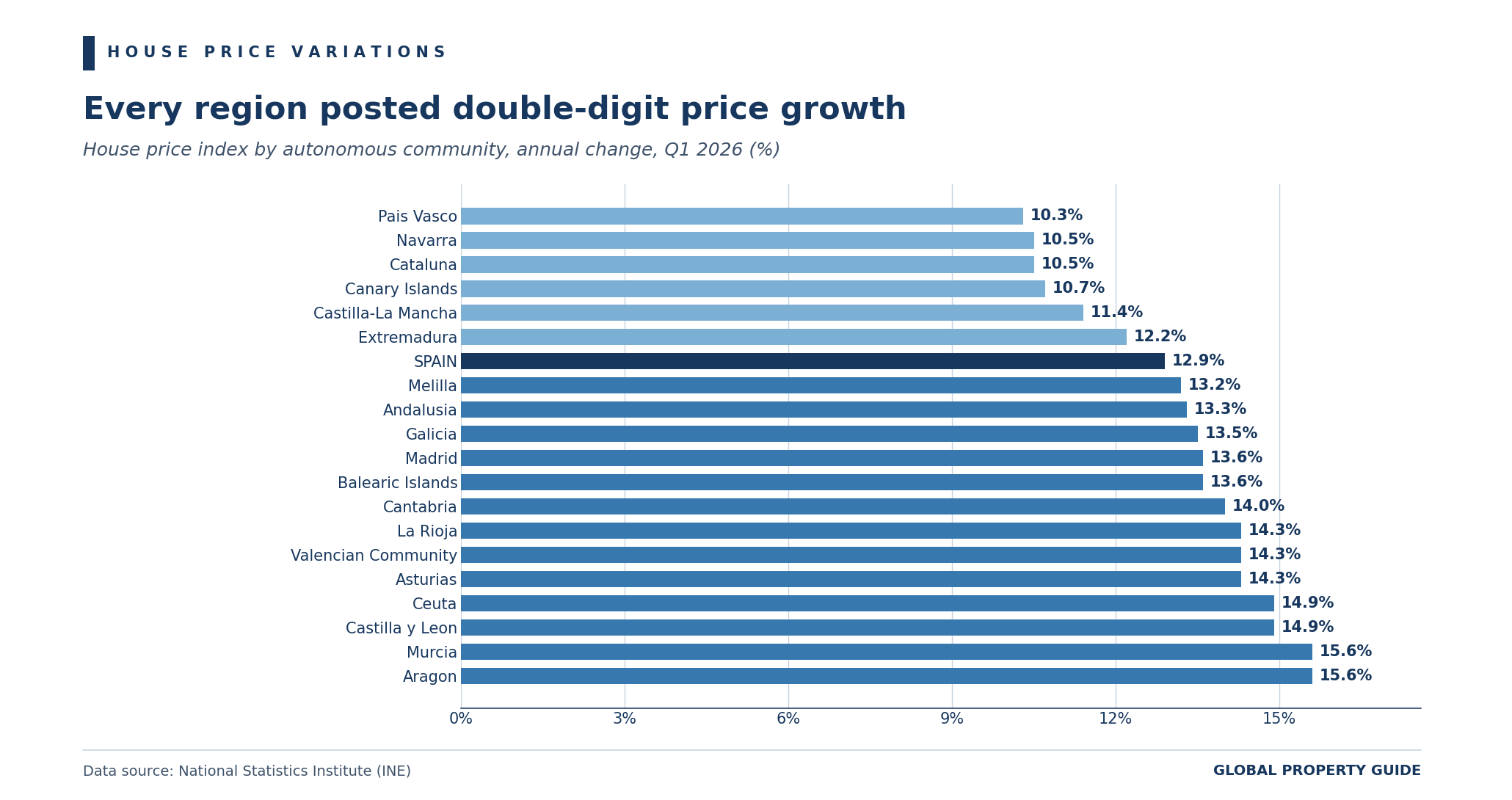
Aragon and Murcia led at 15.6%, followed by Castilla y Leon and the autonomous city of Ceuta at 14.9%. The slowest were the Basque Country at 10.3%, with Navarre and Catalonia both at 10.5%. Thirteen of the nineteen territories outpaced the national rate. Notably, the two largest and most expensive markets sat in the lower half of the table: Madrid at 13.6% and Catalonia at 10.5%. The appraisal series tells the same story, with the province of Madrid up 16.4% and Barcelona up 12.0%, while the eastern and southern coastal provinces and the islands rose 14.4%.
Seven measures, one direction
Spain publishes an unusually large number of house price gauges, and in 2026 they diverge more widely than usual. The range runs from 9.2% to 17.2%.
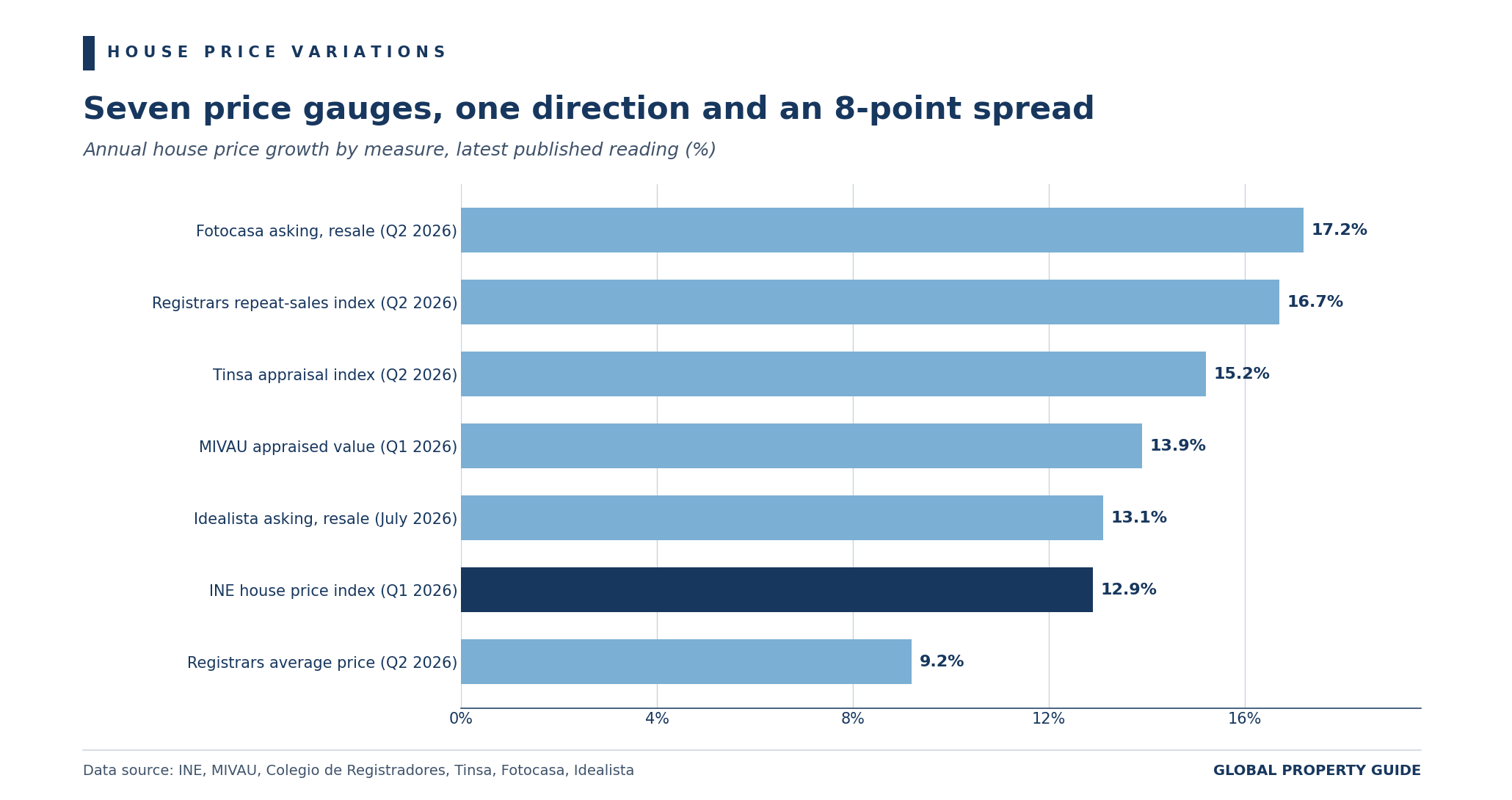
The pattern is systematic rather than random. Asking-price indices sit at the top of the range because they measure what sellers request rather than what buyers pay: Fotocasa reported resale asking prices at EUR 3,133 per square metre in June, up 17.2% and the highest in 21 years, while Idealista put second-hand asking prices at EUR 2,933 in July, up 13.1%. At the other end, the Colegio de Registradores average registered price of EUR 2,487 per square metre rose only 9.2%, because a simple average is pulled around by changes in the mix of what actually sold.
The most reliable readings are the quality-adjusted ones, and they agree. The INE index, which controls for composition through a stratified regression, showed 12.9%. The registrars' repeat-sales index (IPVVR), which tracks the same properties across successive transactions, rose 16.7% and stands 39.31% above its 2007 quarterly peak. Tinsa's appraisal-based IMIE recorded 15.2% nominal growth in Q2 2026 and, importantly, 11.8% after adjusting for inflation, up from 11.5% in the prior quarter. Even stripping out a consumer price shock, real house price growth accelerated.
Where the expensive markets are
Average registered prices by region, Q2 2026:
| AVERAGE REGISTERED HOUSE PRICE BY AUTONOMOUS COMMUNITY, Q2 2026 | ||
| Autonomous community | EUR per sq. m | USD per sq. m |
| Community of Madrid | EUR 4,477 | USD 5,186 |
| Balearic Islands | EUR 4,311 | USD 4,993 |
| Basque Country | EUR 3,616 | USD 4,188 |
| Canary Islands | EUR 3,052 | USD 3,535 |
| Catalonia | EUR 2,995 | USD 3,469 |
| Spain | EUR 2,487 | USD 2,881 |
| Note: | ||
| Data source: Colegio de Registradores de España. | ||
At the provincial level, the ranking is led by Madrid and the Balearic Islands, followed by Gipuzkoa at EUR 4,175 (USD 4,836), Bizkaia at EUR 3,468 (USD 4,017) and Barcelona at EUR 3,406 (USD 3,945). Among provincial capitals, San Sebastian remains the most expensive city in Spain at EUR 6,420 per square metre (USD 7,436), ahead of Madrid at EUR 5,534 (USD 6,410) and Barcelona at EUR 5,045 (USD 5,843).
Historic Perspective
From overbuilding to structural undersupply
Spain's residential market has passed through three broad phases over the past two decades. The pre-2008 cycle was characterised by exceptionally strong development activity and very high transaction volumes. The global financial crisis then triggered a deep correction: house prices fell sharply, sales declined, and residential construction collapsed as financing conditions tightened and the market gradually worked through the large stock accumulated during the boom years.
From 2014 onwards, the market entered a gradual recovery. Prices stabilised and returned to growth, while transaction activity improved steadily, increasingly driven by the second-hand segment. A more supportive macroeconomic environment, including stronger employment, favourable financing conditions and renewed demographic growth, helped underpin demand, while new construction recovered only slowly from its post-crisis lows.
The pandemic caused only a temporary interruption. Demand rebounded quickly and strengthened further, supported by population growth, lower interest rates and improving purchasing power, but the supply response remained limited. Over time, the market shifted from the pre-crisis problem of overbuilding to a new imbalance shaped by persistent underproduction, with new housing delivery failing to keep pace with household formation, particularly in the main urban, coastal and tourism-driven markets.
Two decades of price change
20-year annual house price change, based on end-of-year transaction-based HPI and consumer price index:
| HOUSE PRICES IN SPAIN, ANNUAL CHANGE (%) | |||||
| Year | Nominal | Inflation-adjusted | Year | Nominal | Inflation-adjusted |
| 2006 | n/a | n/a | 2016 | 4.48 | 3.48 |
| 2007 | n/a | n/a | 2017 | 7.19 | 5.66 |
| 2008 | -5.40 | -7.66 | 2018 | 6.61 | 4.82 |
| 2009 | -4.35 | -4.49 | 2019 | 3.61 | 3.15 |
| 2010 | -1.90 | -4.34 | 2020 | 1.48 | 2.22 |
| 2011 | Unlock | Unlock | Unlock | Unlock | Unlock |
| 2012 | Unlock | Unlock | Unlock | Unlock | Unlock |
| 2013 | Unlock | Unlock | Unlock | Unlock | Unlock |
| 2014 | Unlock | Unlock | Unlock | Unlock | Unlock |
| 2015 | Unlock | Unlock | Unlock | Unlock | Unlock |
| Basis: End-of-year transaction-based house price index deflated by the consumer price index. | |||||
| Data sources: INE, OECD, Global Property Guide. | |||||
The table covers completed calendar years only, so the most recent entry remains 2025. On that basis, 2025 delivered the strongest nominal gain of the entire twenty-year window and the strongest inflation-adjusted gain since 2024. Set against the 2011 and 2012 troughs, when real prices fell by 13.55% and 15.40%, the scale of the reversal is considerable.
Property Demand Trends
Transactions have turned negative
The clearest change since the previous edition is that demand has stopped growing. According to the Estadistica Registral Inmobiliaria published by the Colegio de Registradores, 167,934 dwellings were sold in Q2 2026, a fall of 5.7% on the previous quarter and of 2.3% against the same quarter of 2025. It was the lowest quarterly figure in seven quarters and the second consecutive quarterly decline. Fifteen autonomous communities and thirty-four provinces registered falls.
The contraction was sharpest in new construction, where 34,919 operations represented a quarterly drop of 11.5%. Second-hand housing accounted for 133,015 transactions, 4% fewer than in the first three months of the year and 79.2% of the total.
The INE's own registered-transfer series confirms the direction while differing on magnitude. It recorded 169,000 transfers in Q2 2026, down 2.6% year-on-year, following an identical 2.6% decline in Q1. Within the quarter the monthly path was uneven, falling 1.8% in April and 7.3% in May before returning to growth of 1.6% in June.
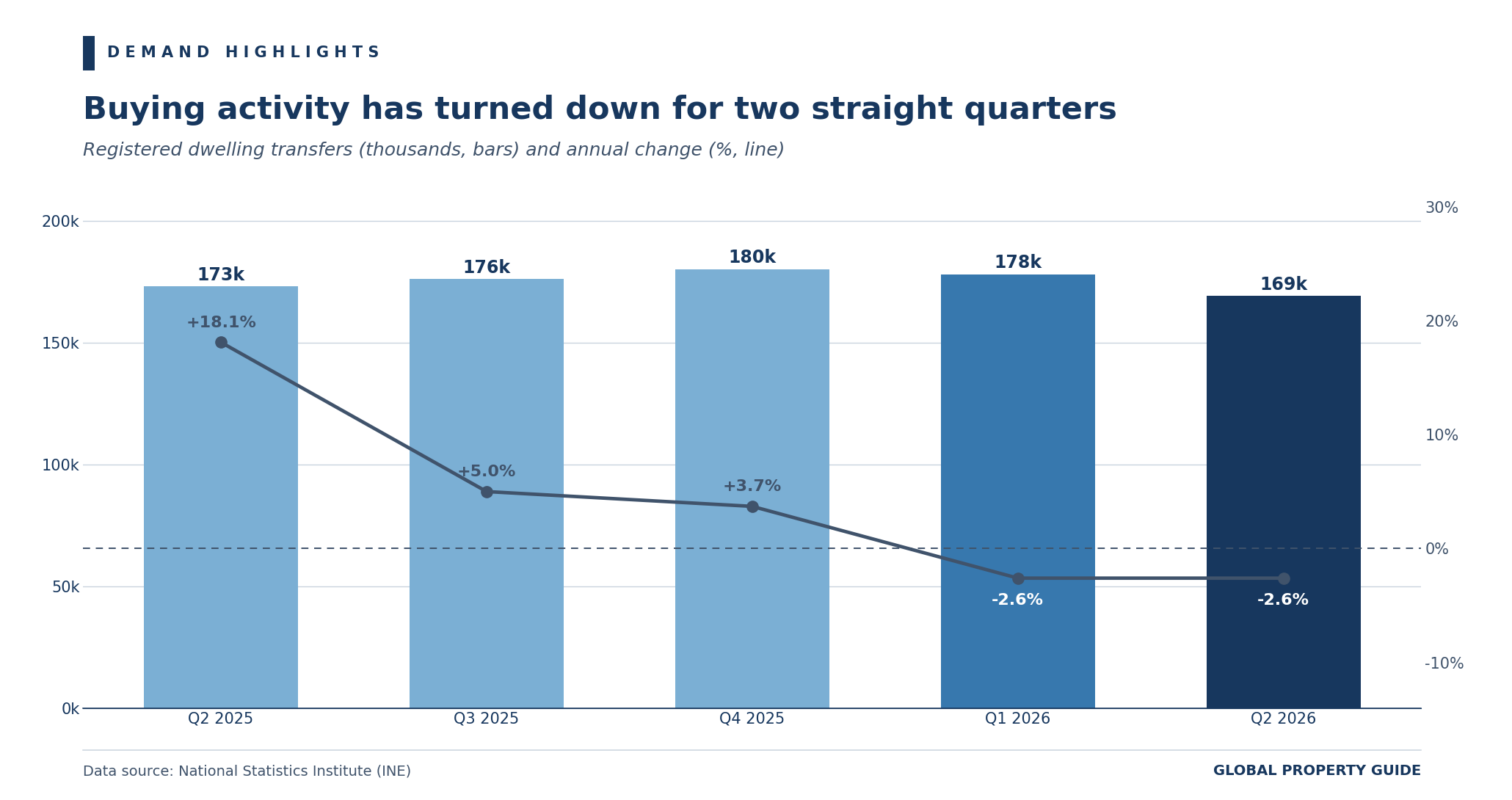
The notarial series is weaker still, with the Ministry of Housing reporting an 11.3% annual decline in Q1 2026 and the notaries' own statistical centre a 7.8% fall. These series are measured at different points in the conveyancing chain and are not directly comparable, but all four now point the same way. For context, 2025 as a whole saw registered transfers rise 11.4% to 713,000, so the turn is recent and sharp rather than a gradual slowing.
Foreign buyers set a record
Against weaker domestic activity, international demand did the opposite. Foreign purchasers accounted for 15.98% of all registered transactions in Q2 2026, the highest share in the history of the series, representing more than 26,800 operations.
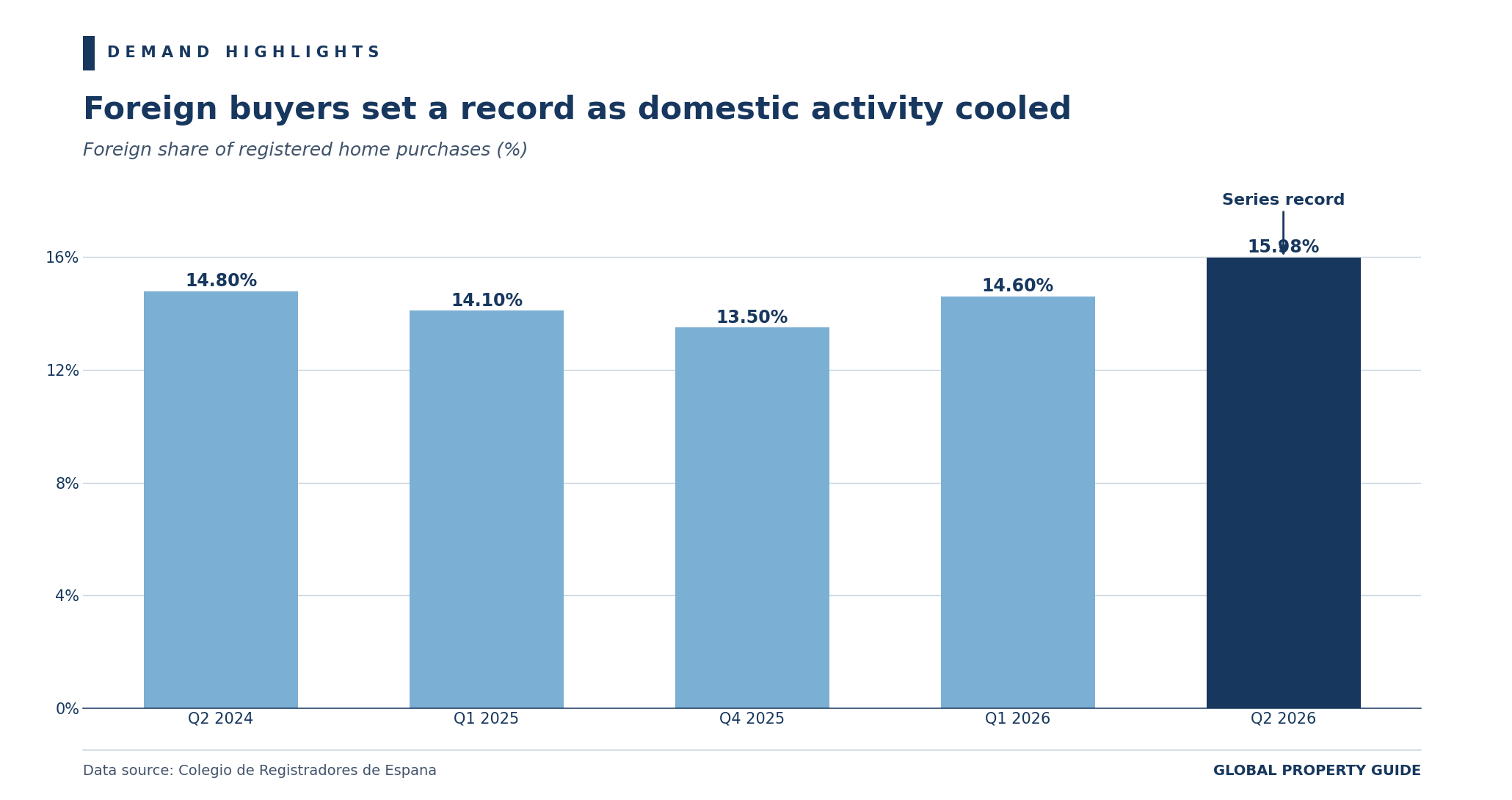
The composition also shifted. European Union citizens made up 57.39% of foreign buyers and the rest of Europe a further 16.75%. By nationality, British buyers remained narrowly in front at 6.99%, but Dutch buyers have moved to essentially level pegging at 6.94%, ahead of Germans at 6.11%. The foreign share increased in every autonomous community, reaching 32.27% in the Balearic Islands and 31.03% in the Valencian Community, roughly double the national rate in both cases.
The combination matters for interpreting the price data. With domestic transaction volumes contracting and foreign participation at a record, the buyer mix is shifting towards a less price-sensitive, less credit-dependent segment concentrated in coastal and island markets. That is consistent with average prices continuing to rise even as the number of deals falls.
Property Supply Trends
Construction has finally accelerated
The previous edition reported that completions were falling despite a stronger pipeline. That has now reversed. According to the Observatory of Housing and Land bulletin published by MIVAU, 39,196 dwellings were started in Q1 2026, an annual increase of 12.7% and the highest first-quarter figure in eighteen years.
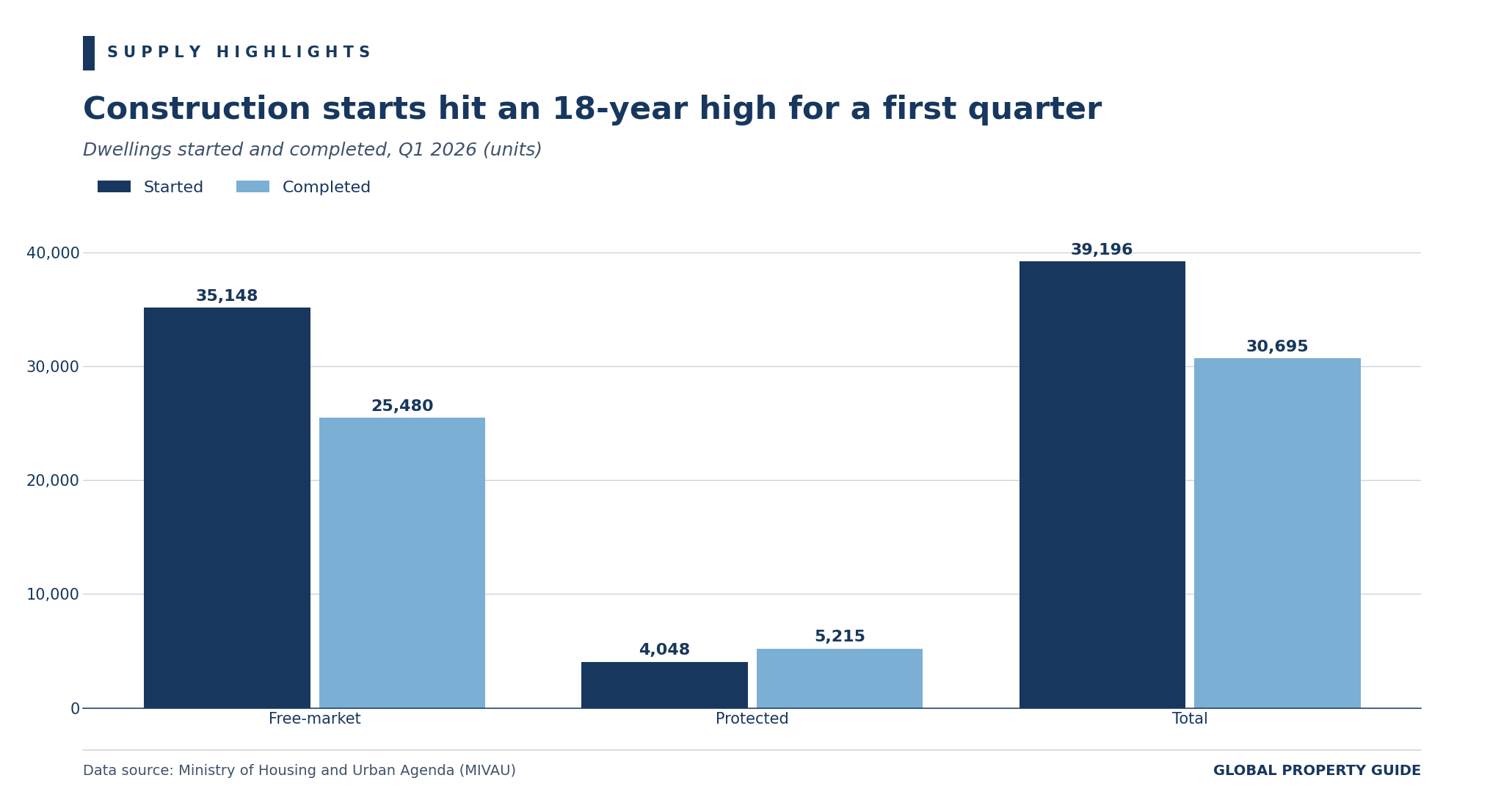
Completions turned as well. Free-market completions reached 25,480 units, up 17.8% year-on-year, reversing the 6.7% decline recorded across 2025 as a whole. Protected housing performed even more strongly, with 5,215 units completed, an increase of 74.9% and the best first quarter in fourteen years. Around six in ten of those protected completions were in Catalonia. Protected starts reached 4,048 units, also a fourteen-year high for a first quarter.
Total completions across both segments came to 30,695 units, against 39,196 starts. The pipeline therefore continues to build faster than it discharges, with starts running at 1.28 times completions, which points to further delivery growth over the next two years.
The gap that remains
Even at this improved pace, output falls well short of household formation. The Banco de Espana reports that the number of households reached 20.00 million in Q2 2026, an increase of 254,000 over twelve months. Annualising the first quarter's completions gives roughly 122,800 homes a year, implying a shortfall of around 131,000 dwellings against new household formation in a single year.
That arithmetic explains why prices have kept rising through a demand slowdown. CaixaBank Research has estimated Spain's accumulated housing deficit at more than 730,000 homes, concentrated geographically, with almost half located in just five provinces: Madrid, Barcelona, Valencia, Alicante and Murcia. BBVA Research has projected new building permits rising by an average of 12.5% across 2026 and 2027 to around 160,000 annual units, while still expecting the accumulated deficit to sit near 800,000 homes by 2027.
The sector's capacity constraint is easing on one measure at least. Construction employment reached 1,743,900 people in Q1 2026 on national accounts data, an increase of 7.0% or 114,300 workers over the year, which is the labour-side condition for the higher start numbers to convert into completions.
Rental Market: Rents and Rental Yields
Asking rents at a record, with a revised yardstick
Asking rents reached a record in July 2026. Idealista reported a national median of EUR 15.3 per square metre per month (USD 17.7), up 6.8% year-on-year, 2.7% over three months and 0.8% on the month.
Spain's rent price index:
This figure is not directly comparable with the 7.1% reported in the previous edition. In July 2026, Idealista revised the methodology of its price index, applying filters that exclude seasonal and holiday lettings from the calculation and adopting more robust outlier detection. The new methodology was applied retroactively across the whole historical series, so internal comparisons within the current series hold, but the level and growth rates differ from those published under the old approach.
Rents rose in 48 of Spain's 50 provinces over the year, with only Alava, down 2.7%, and Gipuzkoa, down 0.9%, declining. Girona led provincial increases at 19.5%. Every autonomous community recorded a rise, led by Aragon at 10.5%, Castilla-La Mancha at 10.0% and Asturias at 9.9%, while Navarre at 0.1% and the Basque Country at 0.3% were effectively flat.
Median asking rents in selected provincial capitals:
| MEDIAN ASKING RENTS BY PROVINCIAL CAPITAL, JULY 2026 | |||
| Capital | EUR per sq. m | USD per sq. m | Annual change |
| Madrid | EUR 23.2 | USD 26.9 | 5.8% |
| Barcelona | EUR 20.1 | USD 23.3 | 2.0% |
| Palma | EUR 19.2 | USD 22.2 | 5.9% |
| San Sebastian | EUR 18.6 | USD 21.5 | -1.8% |
| Malaga | EUR 16.4 | USD 19.0 | 2.5% |
| Valencia | Unlock | Unlock | Unlock |
| Bilbao | Unlock | Unlock | Unlock |
| Spain | Unlock | Unlock | Unlock |
| Note: Exchange rate as of 28 August 2026, EUR 1 = USD 1.1583. Data source: Idealista. | |||
| Data Source: Idealista. | |||
Madrid remains the most expensive capital at EUR 23.2 per square metre, 51.6% above the national median and 2.8 times the cheapest capital, Cáceres, at EUR 8.4. Only two capitals recorded annual falls, San Sebastian and Vitoria-Gasteiz.
Barcelona has stopped falling
The most significant reversal in the rental data concerns Barcelona. The previous edition reported the city as the only major submarket with declining asking rents, down 4.1% in the year to March 2026, and rents were still down 6.1% as late as May. By July 2026, Barcelona had returned to growth at 2.0%.
Evidence on the effect of rent regulation continues to accumulate, and it is not encouraging for the policy's stated aim. Marking one year since A Coruña was declared a stressed zone, Idealista found that prices had continued to rise while the supply of permanent rental housing fell 36%, seasonal listings doubled, and competition between households for each available home increased by 85%.
Regulated rents and yields
Rent increases on existing contracts remain far more contained than asking rents for new lettings. The Banco de Espana reports the consumer price index component for rents at 2.6% in Q2 2026, up modestly from 2.4% across 2025, leaving a gap of 4.2 percentage points against the asking-rent measure. That divergence is the mechanical result of indexation rules that tie sitting tenants' increases to a reference index while new contracts reprice to market.
Research conducted by Global Property Guide showed gross rental yields for apartments in Spain averaging 5.45%, against 5.43% in the preceding survey.
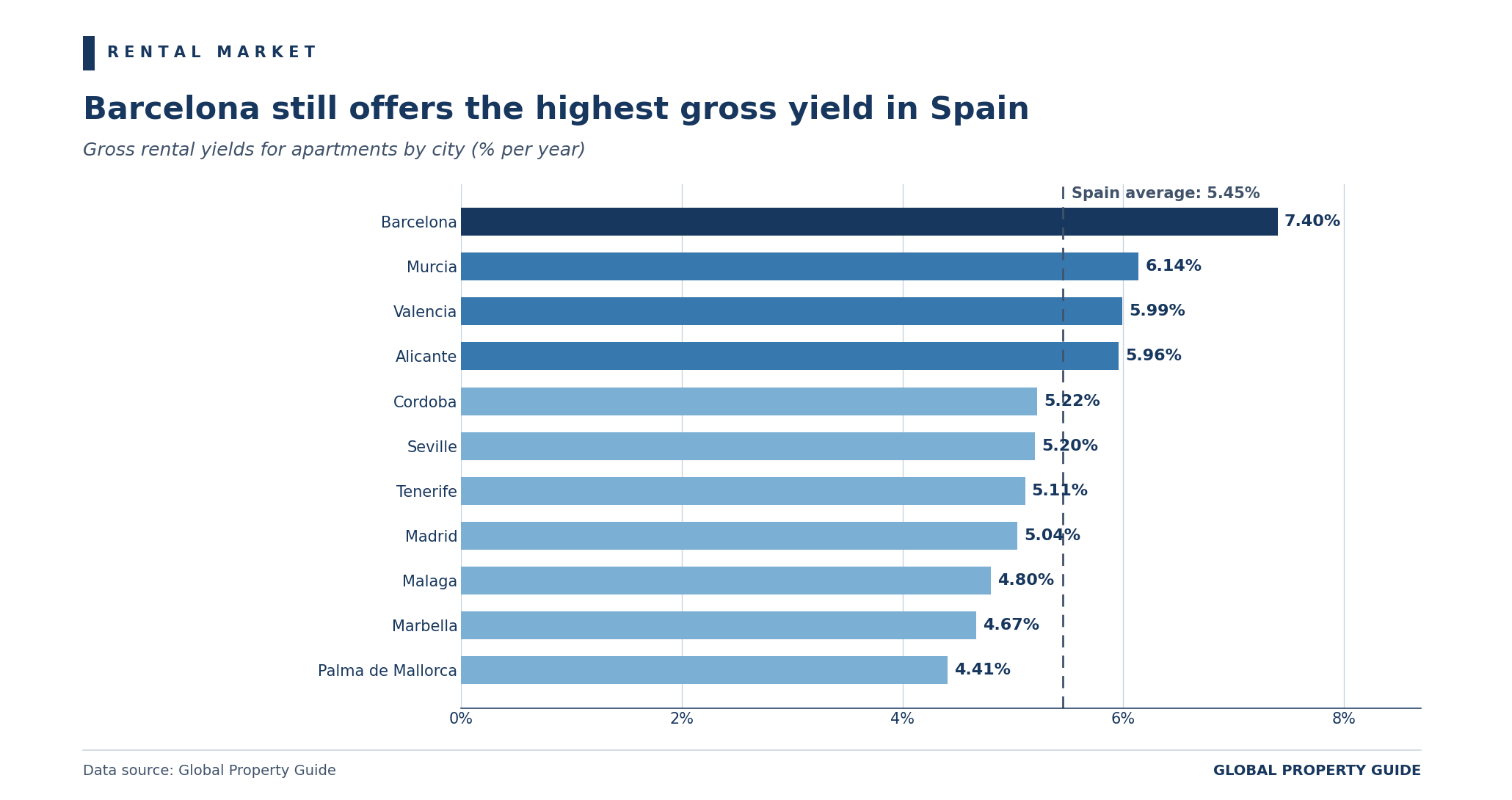
Barcelona offered the highest yields among the surveyed submarkets at 7.40%, followed by Murcia at 6.14% and Valencia at 5.99%, while the lowest were recorded in Palma de Mallorca at 4.41% and Marbella at 4.67%. Barcelona's position at the top of the yield table while its rents were falling for much of the past year reflects the fact that its purchase prices fell relative to rents rather than any rental outperformance.
Two caveats apply to these figures. The yield survey is conducted twice yearly, and its next update is scheduled for September 2026, so the readings above are unchanged from the previous edition. Separately, the Banco de España publishes a much lower gross rental yield of 2.9% for Q2 2026; the two are not comparable, as they cover different property universes and use different rent and price bases.
Tenure and regulation
According to Eurostat's survey of living conditions, the share of Spanish households renting rose to 20.4% in 2024 from 18.0% in 2021, while outright and mortgaged ownership fell to 73.6%.
The policy framework, meanwhile, is less settled than the previous edition anticipated. Royal Decree-Law 8/2026 of 20 March introduced an extraordinary two-year extension for tenancies expiring before 31 December 2027 together with a 2% cap on annual rent updates. Congress declined to ratify it on 28 April 2026, and the non-ratification took effect on 30 April, so the measure was in force for roughly five weeks before lapsing. The applicable regime reverted to the general Urban Leases Act.
A replacement package was scheduled for approval by the Council of Ministers on 28 July 2026 but was withdrawn from the agenda the previous day for want of parliamentary support, and has been postponed to September. As trailed, it would bring seasonal and room lettings within the Urban Leases Act, extend tenancies to 30 June 2028, raise value added tax on tourist accommodation from 10% to 21%, and offer income tax relief to landlords who reduce rents. Until Congress votes, the operative framework remains the 2023 Housing Law and the stressed-area designations made under it.
Mortgage Market and Interest Rates
The ECB has reversed course
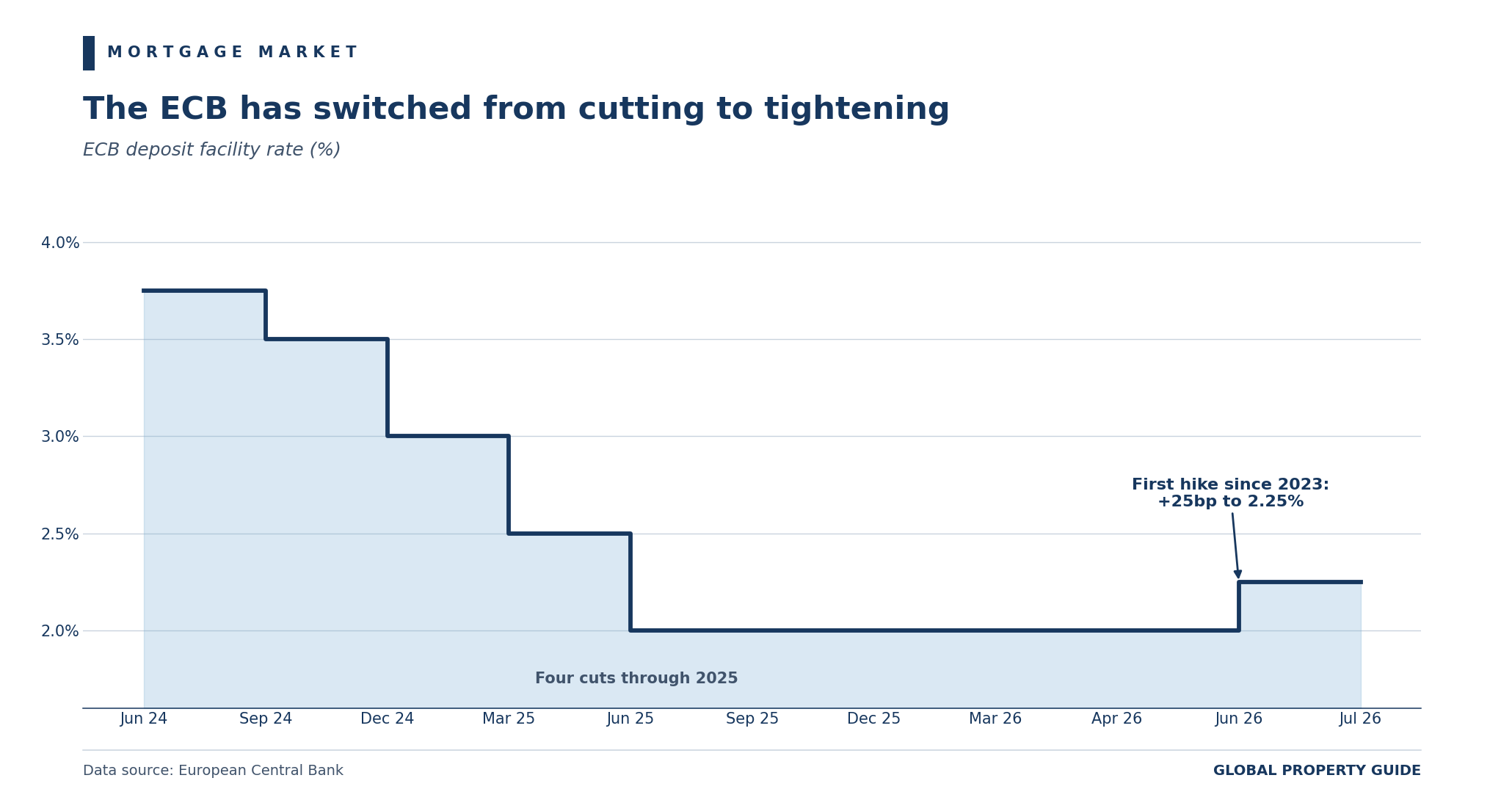
The single most consequential change since the previous edition is the direction of monetary policy. On 11 June 2026 the ECB Governing Council decided to raise its three key interest rates by 25 basis points, taking the deposit facility to 2.25%, the main refinancing operations rate to 2.40% and the marginal lending facility to 2.65% with effect from 17 June. It was the first increase since 2023. The Council attributed the decision to the conflict in the Middle East, stating that "the war in the Middle East is generating inflation pressures", and said the move was robust across a range of scenarios for how the shock might evolve.
Spain's mortgage loan interest rates:
Alongside the decision, Eurosystem staff revised their projections upwards, expecting headline euro area inflation to average 3.0% in 2026, 2.3% in 2027 and 2.0% in 2028, and downwards for growth, at 0.8% in 2026 and 1.2% in 2027. At its following meeting on 23 July, the Council held rates unchanged, observing that the full inflationary impact of the energy shock had yet to play out.
Market rates have followed
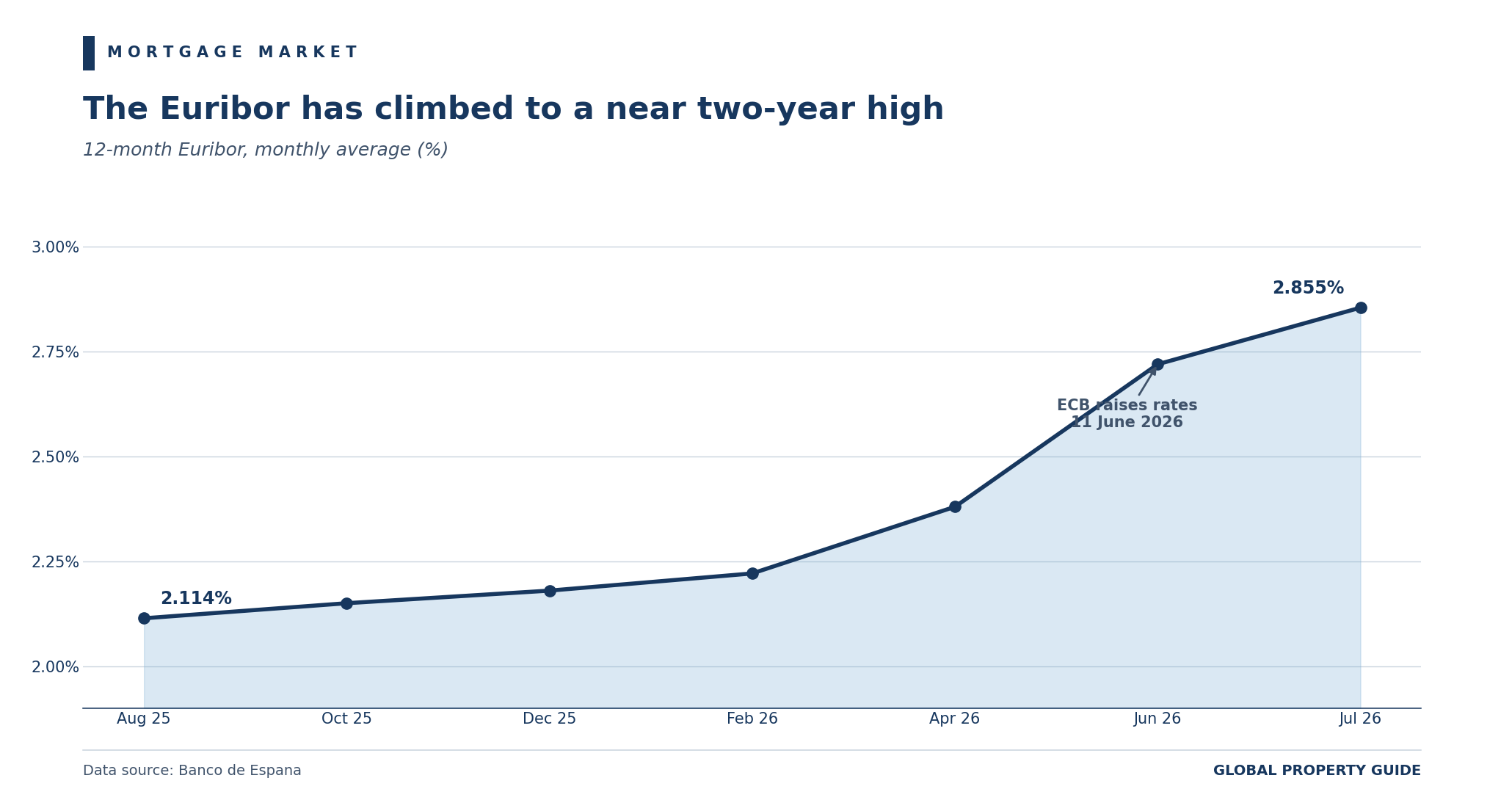
The 12-month Euribor, the reference for most Spanish variable-rate mortgages, closed July 2026 at a monthly average of 2.855%. That is 74 basis points above its August 2025 level of 2.114%, 63 basis points above February 2026, and the highest reading since September 2024.
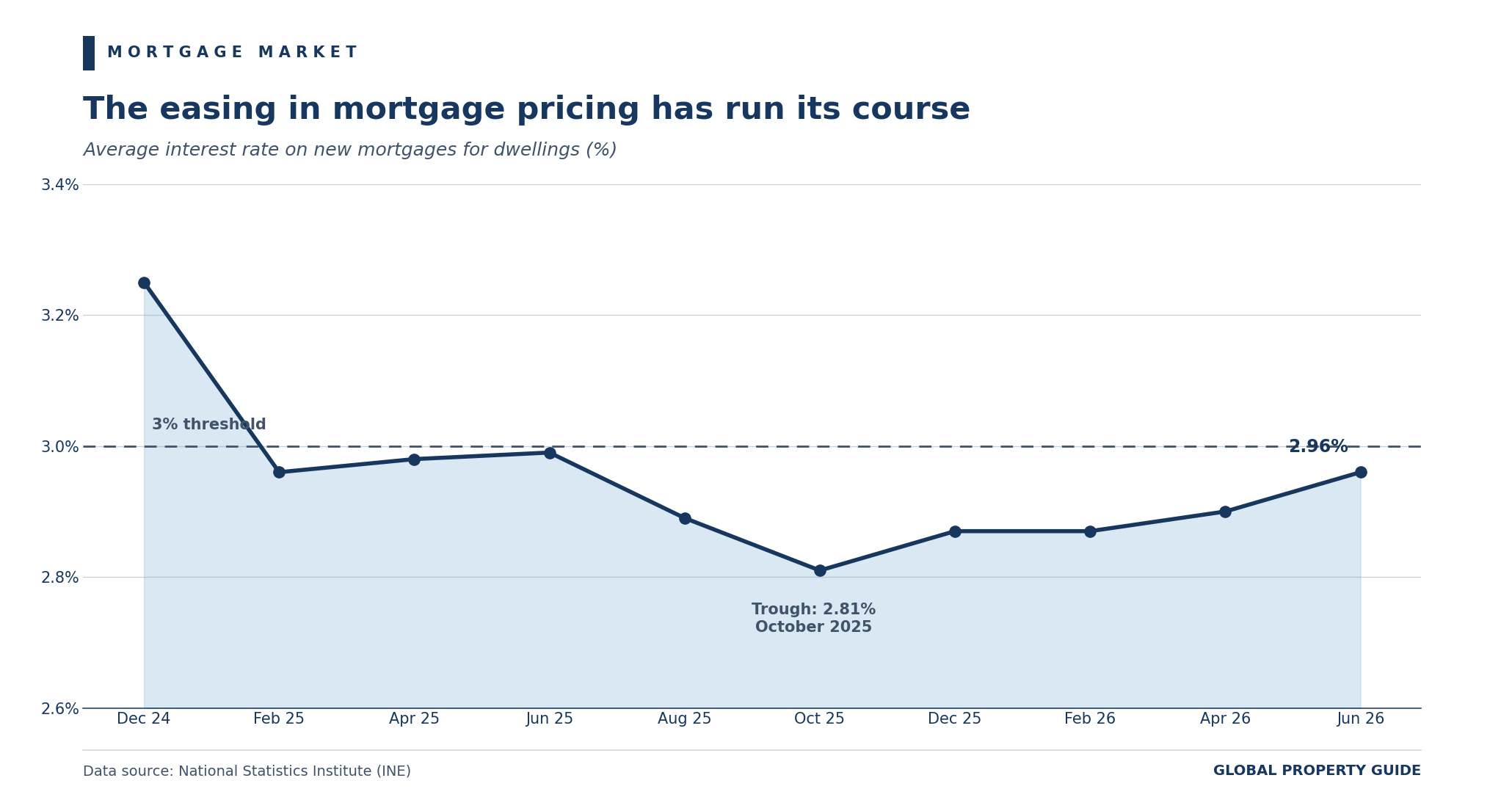
Retail mortgage pricing has begun to follow, though with a lag and from a low base. The INE's mortgage statistics put the average interest rate on new mortgages for dwellings at 2.96% in June 2026, marginally below May's 2.98% but above the 2.81% trough recorded in October 2025. June was the seventeenth consecutive month with an average rate below 3%.
The composition of new lending shows borrowers positioning for higher rates. In June 2026, 61.7% of new mortgages on dwellings were taken at fixed rates against 38.3% variable, with average starting rates of 2.89% and 3.07% respectively. The variable share has nonetheless risen from 33.3% in January, as the fixed-rate premium widened.
Volumes are still expanding
Lending activity has so far been unmoved by the turn in rates. June 2026 saw 45,907 new mortgages on dwellings, an annual increase of 10.8% and the highest June figure since 2010. The first half of 2026 closed with 259,681 new mortgages, 7.0% more than a year earlier.
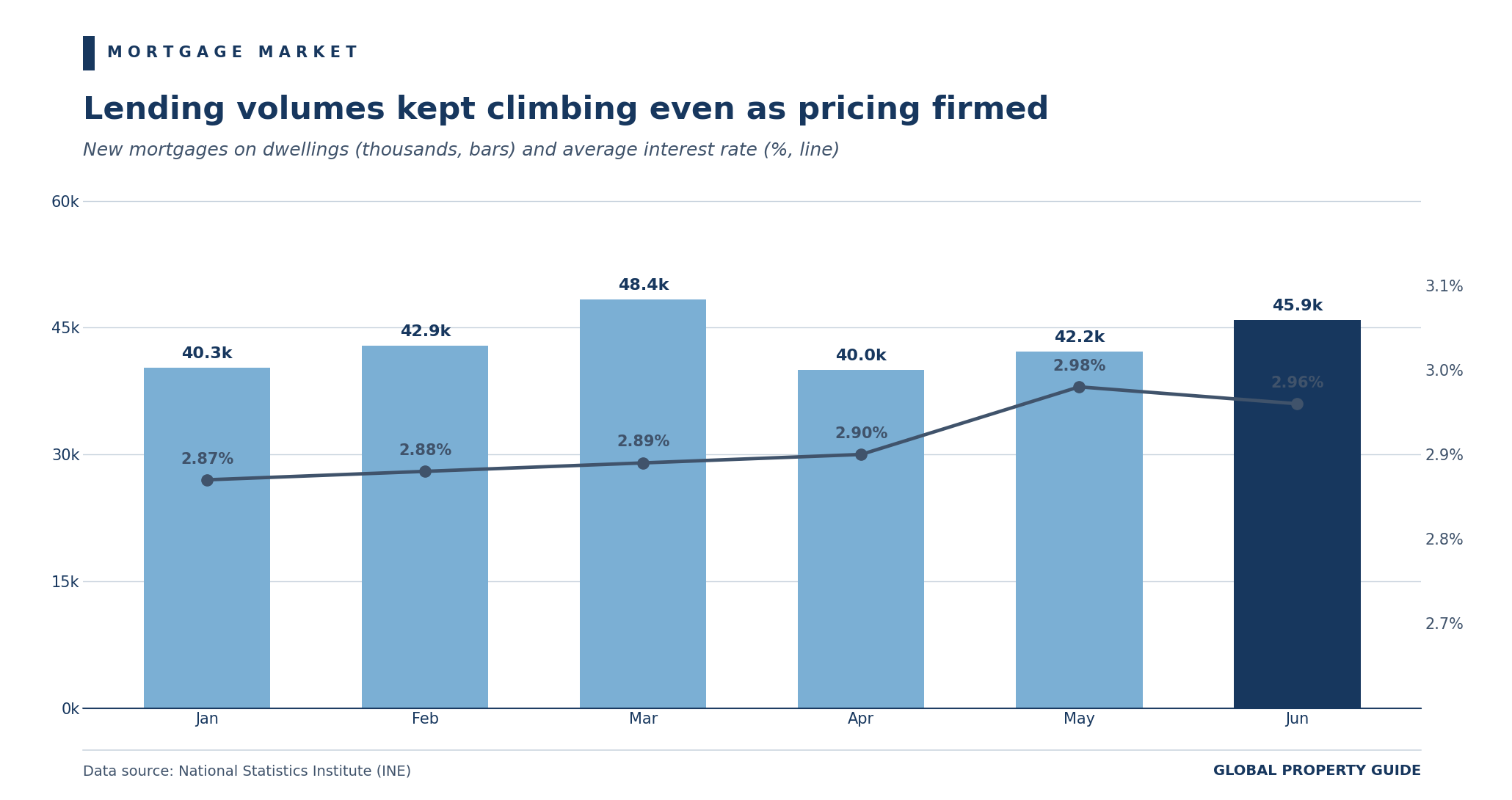
Loan sizes have grown faster than loan counts. The average mortgage on a dwelling reached EUR 178,365 (USD 206,606) in June, the highest on record and 6.0% above a year earlier, with total capital lent up 17.5%. Average maturity held at 25 years.
Key indicators for new mortgage lending on dwellings:
| NEW MORTGAGE LENDING ON DWELLINGS, KEY INDICATORS | ||
| Indicator | Latest | Year earlier |
| Number of new mortgages, June | 45,907 | 41,432 |
| Average amount, June | EUR 178,365 | EUR 168,269 |
| Average interest rate, June | 2.96% | 2.99% |
| Average term, June | 25 years | 25 years |
| Loan-to-value on new operations | 63.7% | 64.8% |
| Share of new loans above 80% loan-to-value | 9.6% | 11.3% |
| Note: Loan-to-value figures are Q2 2026 against the 2025 average; year-earlier volume and amount figures are implied from published annual growth rates. | ||
| Data sources: INE, Banco de Espana. | ||
Risk indicators are improving
Notably, faster lending has not come with looser standards. The Banco de España reports the average loan-to-value ratio on new operations easing to 63.7% in Q2 2026 from 64.8% across 2025, and the share of new loans written above 80% loan-to-value falling to 9.6% from 11.3%. The non-performing ratio on household housing loans declined to 1.63% in Q1 2026 from 2.00% in 2025.
The stock of mortgage debt also continues to shrink relative to the economy, standing at 30.3% of GDP in Q2 2026 against 33.2% in 2023. Financing intensity within the transaction itself, however, is rising: the registrars recorded 129,240 mortgages on dwellings in Q2 2026, equivalent to 77% of purchases, an increase of 1.9 percentage points on the quarter. Average mortgage debt per dwelling reached EUR 176,453 (USD 204,395), a ninth consecutive quarterly record, and debt per square metre rose to EUR 1,861 (USD 2,155) in a thirteenth consecutive quarterly increase.
Economic and Social Factors
Growth remains solid
Spain's economy continued to outperform its euro area peers. The INE's advance estimate put GDP growth at 0.7% in Q2 2026 against the previous quarter, a tenth above the first quarter, and at 2.7% year-on-year for a fourth consecutive quarter. National demand contributed 3.3 percentage points while external demand subtracted 0.6.
Construction was among the stronger sectors, with gross value added rising 4.1% year-on-year, comfortably ahead of the economy as a whole, and 0.6% over the quarter.
The Banco de España maintained its growth forecasts at 2.3% for 2026 and 1.7% for 2027 in its June projections. The 2026 figure is close to three times the 0.8% the Eurosystem expects for the euro area as a whole. Governor Jose Luis Escriva identified housing and productivity as the two structural challenges facing the Spanish economy.
Inflation has become the problem
The favourable inflation picture described in the previous edition has deteriorated markedly. The INE's flash estimate put annual CPI inflation at 4.3% in August 2026, seven tenths above July's 3.6% and the highest reading since February 2023. The monthly increase of 0.7% was the largest for an August since 1992.
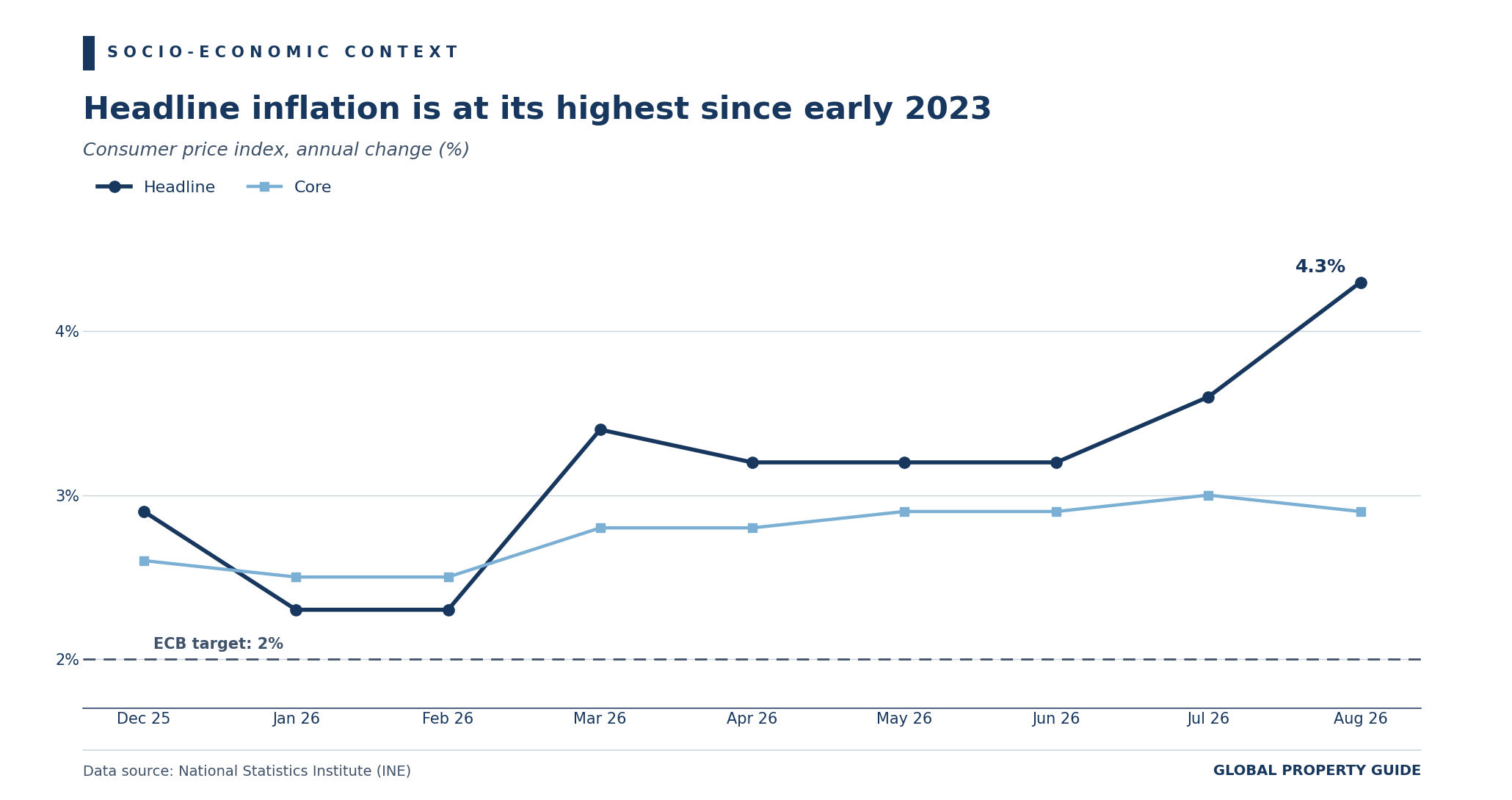
The composition of that increase matters for the housing market. Core inflation, which excludes unprocessed food and energy, actually fell a tenth to 2.9%, leaving a gap of 1.4 percentage points against the headline rate. The rise is being driven by vehicle fuels, an imported energy shock rather than domestic demand pressure. Food and non-alcoholic beverages rose just 1.6%.
On the harmonised measure used for European comparison, Spanish inflation reached 4.5% in August, against 2.9% for the euro area in July, and more than double the ECB's 2% target. The Banco de Espana revised its 2026 inflation forecast up six tenths to 3.6% in June, with 2.6% expected for 2027. Definitive August figures are due on 15 September.
Employment at a record, affordability at a low
The labour market remains the strongest support for housing demand. The Q2 2026 Labour Force Survey recorded 22,779,000 people in employment, an all-time high, following a quarterly increase of 486,000 and an annual increase of 510,200. Unemployment fell to 9.87%, below 10% for the first time in a second quarter since 2008, with 2,495,300 people unemployed. Construction added 56,600 jobs over the quarter.
Less positively, the temporary employment rate rose three-tenths to 15.1%, and 892,500 people, or 35.8% of the unemployed, had been out of work for more than a year.
Affordability, however, has deteriorated sharply. The Banco de Espana reports the ratio of house prices to household disposable income rising to 8.0 years in Q1 2026 from 7.6 in 2025 and 7.1 in 2024. The theoretical annual effort required to service a mortgage rose to 36.1% of income from 34.3%.
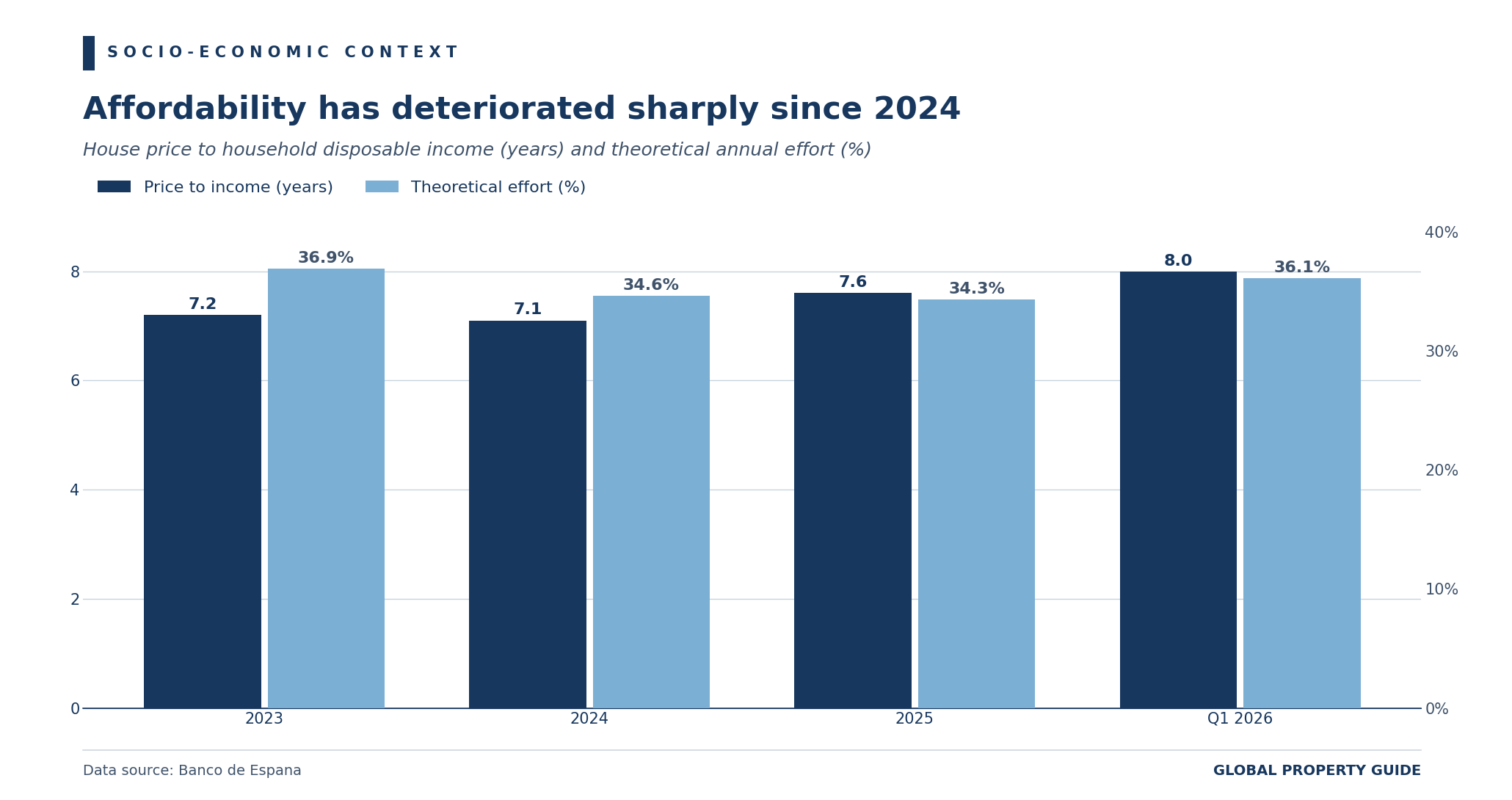
Tinsa's parallel measure moved the same way, reaching 35.7% of disposable income for the first mortgage payment against 33.8% in the previous quarter. Both readings are now above their 2023 levels, undoing the improvement delivered by the 2024 and 2025 rate-cutting cycle.
What to watch
Three developments will shape the market over the remainder of 2026. The ECB Governing Council meets on 9 and 10 September with new staff projections, and market pricing implies a deposit rate of 2.80% by March 2027 with roughly a 60% probability of reaching 3%. The postponed housing decree returns to the Council of Ministers in September, with ratification requiring support that the government has not yet secured. And the INE publishes second-quarter house price data in early September, the first reading that will show whether prices responded to the transaction slowdown that began in the first quarter.
Sources:
- National Statistics Institute (INE)
- Housing Price Index (HPI). Base 2025. First Quarter 2026: ine.es
- Quarterly National Accounts of Spain. Second Quarter 2026. Advance: ine.es
- Flash Estimate of the Consumer Price Index (CPI), August 2026: ine.es
- Consumer Price Index (CPI), December 2025: ine.es
- Economically Active Population Survey (EAPS), Q2 2026: ine.es
- Mortgage Statistics, Latest Data: ine.es
- Mortgage Statistics, January 2026: ine.es
- Banco de Espana
- Ministry of Housing and Urban Agenda (MIVAU)
- Observatory of Housing and Land Bulletin 57, First Quarter 2026: mivau.gob.es
- Appraised Value of Housing Series: mivau.gob.es
- Housing and Land Observatory: mivau.gob.es
- Colegio de Registradores de Espana
- Property Registry Real Estate Statistics, Second Quarter 2026: infoconstruccion.es
- Property Registry Statistics Portal: registradores.org
- European Central Bank (ECB)
- Monetary Policy Decisions, 11 June 2026: ecb.europa.eu
- Monetary Policy Decisions, 23 July 2026: ecb.europa.eu
- Economic Bulletin, Issue 5, 2026: ecb.europa.eu
- Key ECB Interest Rates: ecb.europa.eu
- Eurostat
- Distribution of Population by Tenure Status, Type of Household and Income Group: ec.europa.eu
- CaixaBank Research
- New Housing is Lacking Where it is Needed Most (ES): caixabankresearch.com
- Spain's Housing Market is Entering a New Expansionary Phase: caixabankresearch.com
- BBVA Research
- Spain, Real Estate Sector Outlook and Profitability, March 2026: bbvaresearch.com
- Tinsa by Accumin
- IMIE Local Markets, Second Quarter 2026: accumin.com
- Idealista
- Rental Prices in Spain Rise 6.8% Year-on-Year in July (ES): idealista.com
- One Year of the Rent Cap in A Coruna (ES): idealista.com
- Housing Prices in Madrid in July (ES): idealista.com
- Rental Price Report: idealista.com
- Euronews
- Spain House Prices: Resale Homes Rise 17.2% to the Highest Level in 21 Years: euronews.com
- Official State Gazette (BOE)
- Royal Decree-Law 8/2026 of 20 March, Rental Measures (ES): boe.es
- Global Property Guide
- Gross Rental Yields in Spain: globalpropertyguide.com