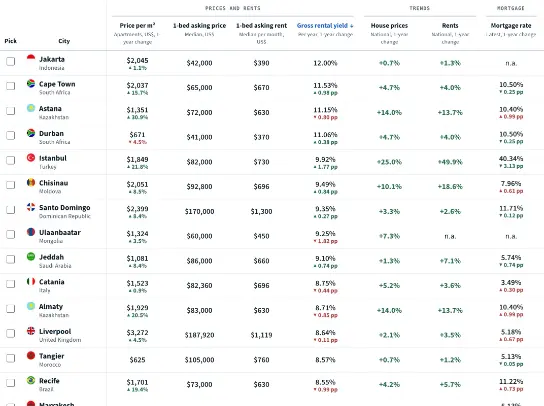
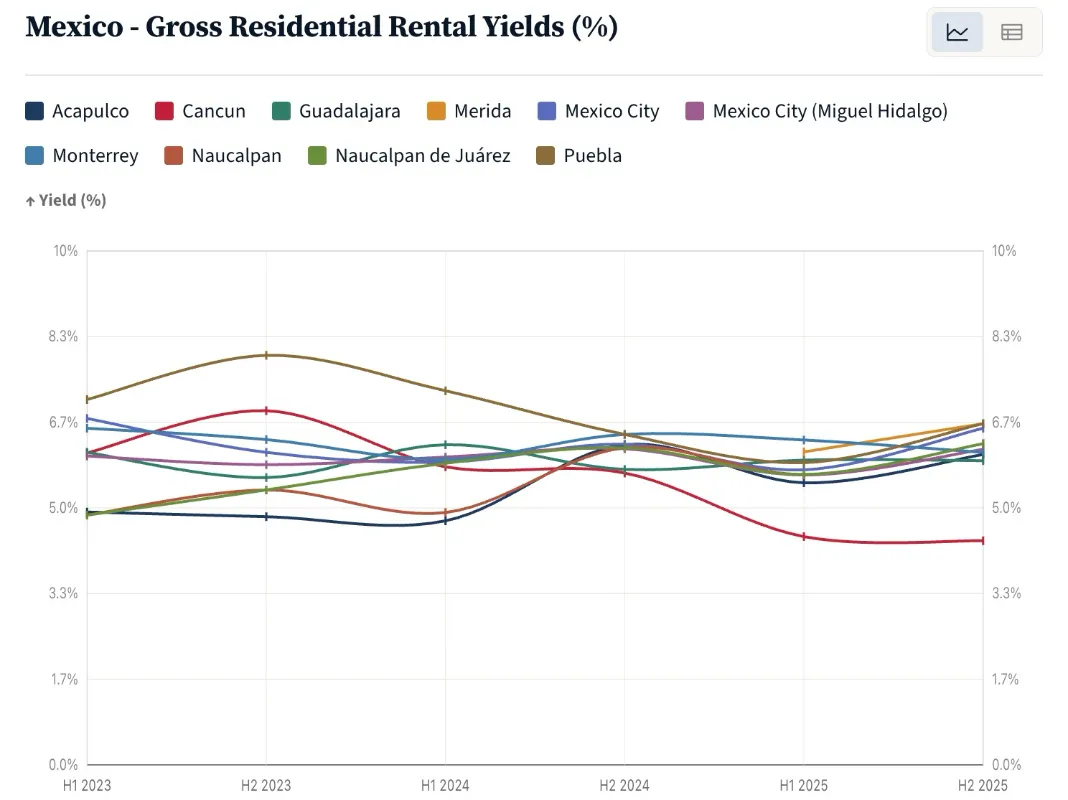
Good yields on larger Bangkok apartments reflect the Thai capital's moderate price rises.
Thailand's housing market has stabilised rather than recovered. Transaction volumes turned positive in early 2026 for the first time in three years, but the rebound is confined almost entirely to homes priced below the government's THB 7 million fee-relief threshold, and it rests on stimulus measures that have now been extended to the middle of 2027. Prices are barely moving, unsold inventory is enormous, and roughly two in five mortgage applications from ordinary buyers are still being turned down.
This extended overview from Global Property Guide covers key aspects of the Thai housing market and takes a closer look at its most recent developments and long-term trends.
Note on currency: figures are converted at THB 33.0 per USD, the prevailing rate in early August 2026.
Table of Contents
- Property Prices and Price Index
- House Price Variations
- Property Demand Trends
- Property Supply Trends
- Rental Market: Rents and Rental Yields
- Mortgage Market and Interest Rates
- Historic Perspective
- Economic and Social Factors
Property Prices and Price Index
Thailand's residential price growth remained weak through the first quarter of 2026, even as transaction activity improved. The nationwide Residential Property Price Index compiled by the Bank of Thailand (BOT) rose by 1.26% year on year in Q1 2026, up from 0.63% in Q4 2025 but still far below the pace of general cost increases now working through the economy. Single-detached house prices increased by 1.57% and townhouse prices by 1.06%.
Thailand's house price annual change:
Adjusted for inflation, the picture is marginally better than the nominal figure suggests, because consumer prices were still falling early in the year. With headline inflation averaging -0.5% in Q1 2026, according to the National Economic and Social Development Council (NESDC), the real annual increase in the nationwide index works out at roughly 1.8%. That advantage is temporary: inflation turned positive in April and reached 1.95% in July, which means real price growth is likely to have gone negative during the second quarter.
The constraint on pricing is not demand for housing as such but the inability of buyers to pay for it. Developers are competing hard on price at the mass-market end while holding headline figures steady through incentives. The Real Estate Sales and Marketing Association reported in late July that new-home prices had been cut by an average of 10% to 30% in the current downturn, with campaigns marketed on the basis of several years of free occupancy alongside waived transfer fees. A detached house listed at THB 4 million (USD 121,212) in provincial markets was cited as being discounted by THB 1 million (USD 30,303).
Consultancy views on the outlook diverge sharply by segment. CBRE expects average asking prices for downtown Bangkok condominiums to rise by as much as 15% during 2026, but this reflects a change in the mix of what is being launched rather than broad appreciation, with new supply concentrated in luxury and super-luxury projects. JLL sees inventory-clearance pressure continuing to weigh on capital values, and forecasts growth of just 1.7% for the year in the high-end segment. For the bulk of the market, competing against more than 200,000 unsold units in Greater Bangkok, meaningful price growth remains improbable.
House Price Variations
Regional divergence is now the defining feature of Thai house prices, and the gap is widening. In Q1 2026, the South recorded the strongest annual increase at 5.59%, followed by the Northeast at 2.61% and the North at 2.33%. Bangkok and its surrounding provinces were the only region to register a decline, with the regional index falling by 0.18%.
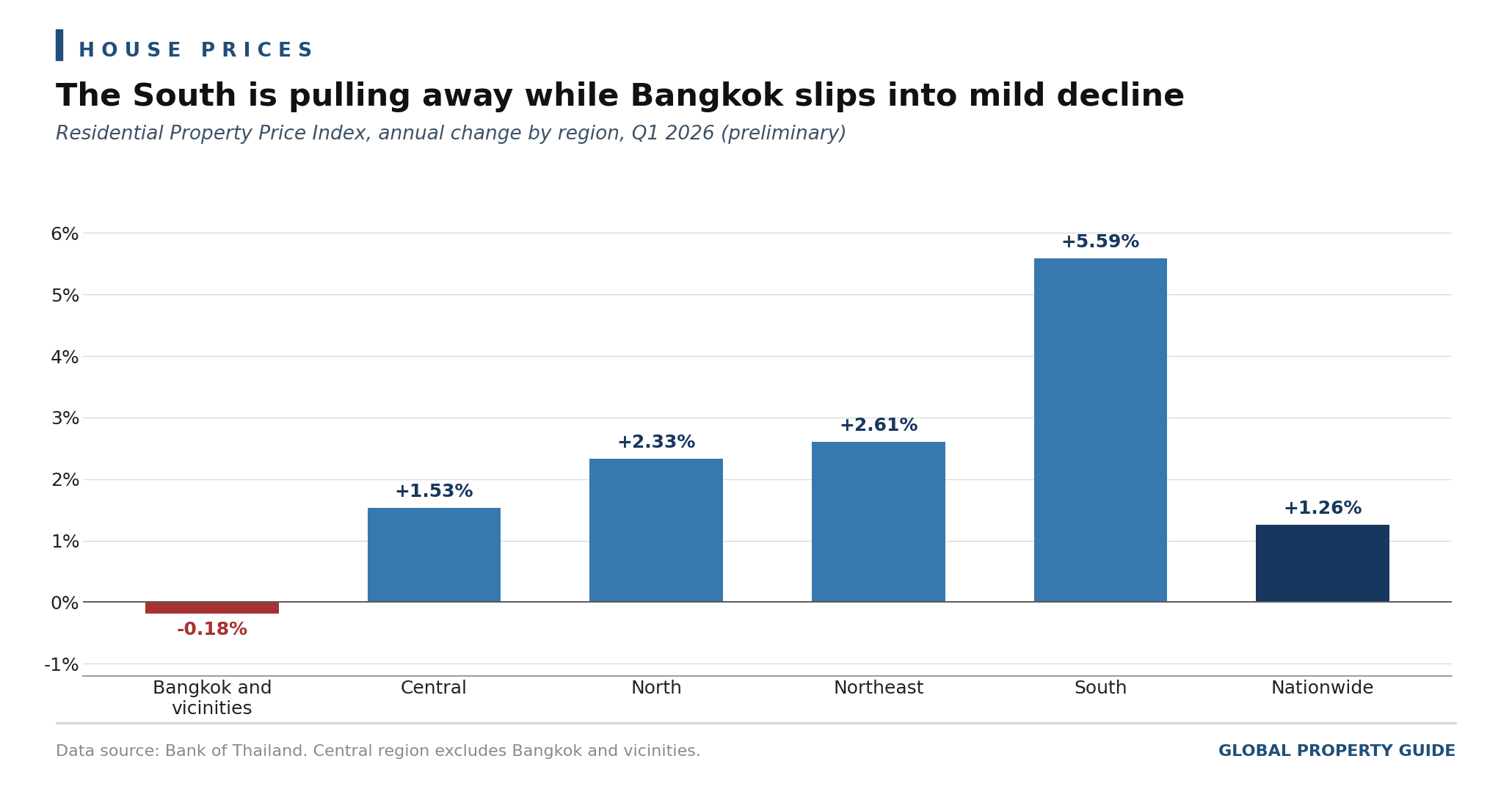
Within Bangkok and its vicinities, the composition of that decline is instructive. Condominiums were the only segment to record growth, rising 1.95%, while townhouse prices were broadly unchanged, and single-detached house prices fell by 1.59%. The condominium gain reflects the shift of new launches towards prime, transit-connected locations rather than any broad recovery in apartment values, since the same period saw JLL report central-area capital values down 1.3% quarter on quarter.
The longer view makes the regional split starker. Over five years to Q1 2026, prices in the South have risen 20.10% and in the Northeast 17.58%, against 10.61% in Bangkok and its vicinities. The capital has therefore delivered barely half the cumulative appreciation of the strongest region, and less than the nationwide figure of 13.53%.
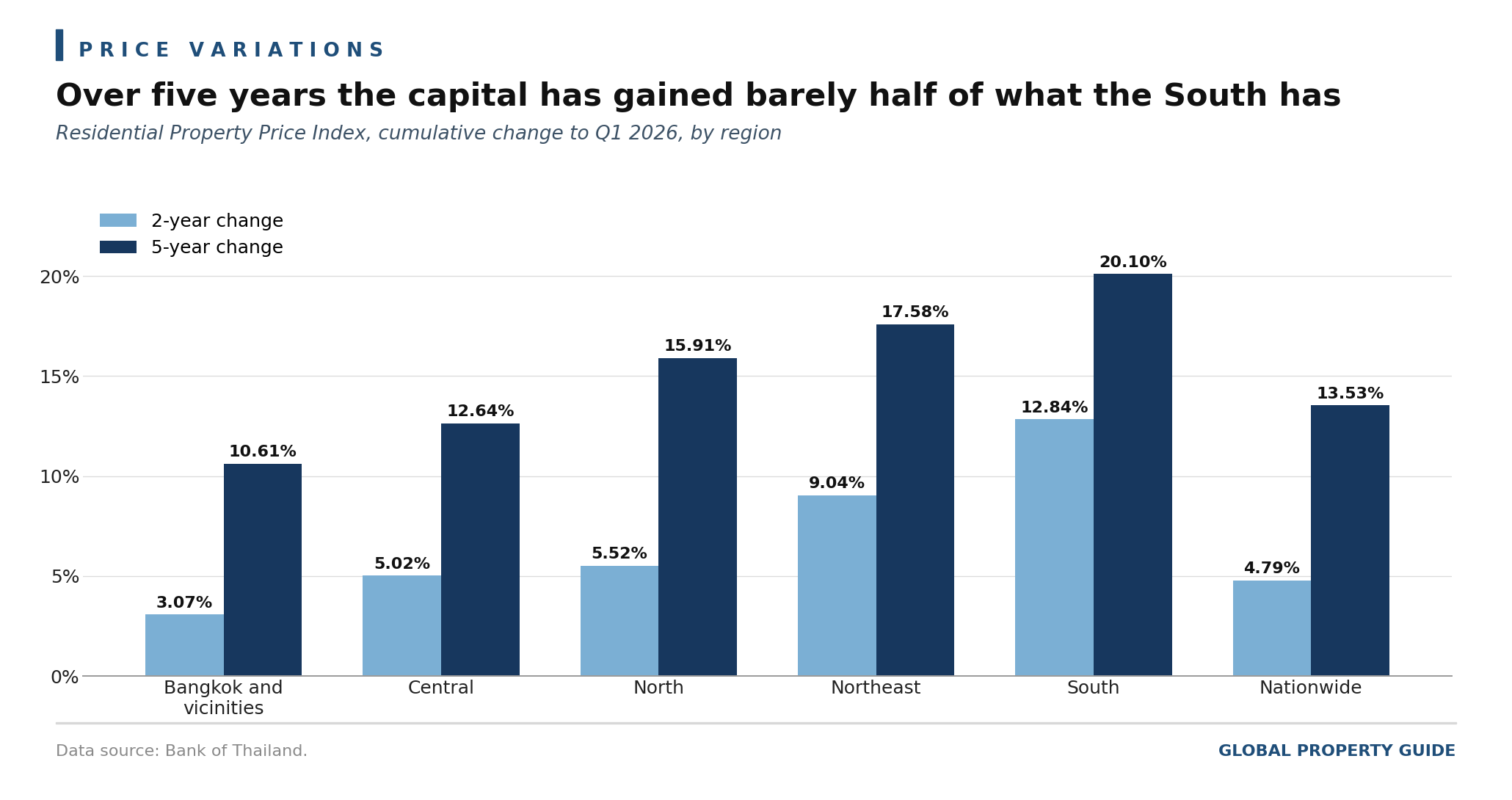
| Residential Property Price Index, by region: | |||
| Region | YoY, % Q1 2026 |
2-year change, % Q1 2026 |
5-year change, % Q1 2026 |
| Bangkok and vicinities | -0.18% | 3.07% | 10.61% |
| Central | 1.53% | 5.02% | 12.64% |
| North | 2.33% | 5.52% | 15.91% |
| Northeast | 2.61% | 9.04% | 17.58% |
| South | Unlock | Unlock | Unlock |
| Nationwide | Unlock | Unlock | Unlock |
| Note: Q1 2026 figures are preliminary. The central region excludes Bangkok and vicinities. Indices for single-detached houses and townhouses include land. | |||
| Data Source: Bank of Thailand. | |||
Two forces explain the pattern. The first is supply: Greater Bangkok absorbed an enormous condominium building programme in the decade to 2019 and is still working through the residue, whereas provincial markets never built at that intensity. The second is tourism and foreign money, which has supported the South, and particularly Phuket, in a way that has no equivalent in the capital's mass-market suburbs. Notably, one Bangkok fringe submarket, Tiwanon and Nuan Chawee, where units cluster in the THB 1 million to 2 million range, saw prices fall by an average of 8.3% in a single year.
Property Demand Trends
Cautious Recovery Confined to the Affordable Segment
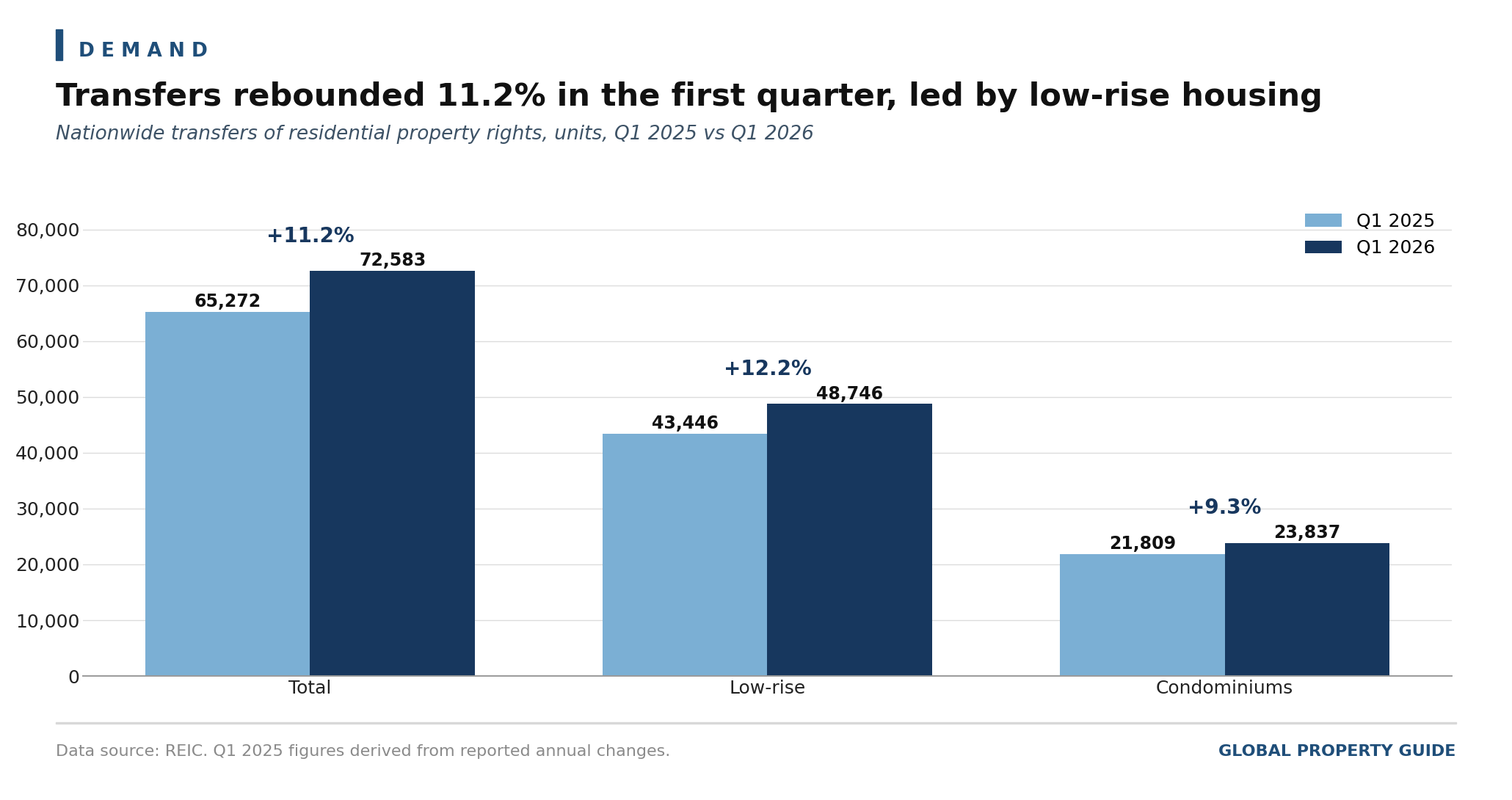
After three years of contraction, Thai housing demand finally turned. Nationwide residential property transfers increased by 11.2% year on year to 72,583 units in Q1 2026, according to the Real Estate Information Center (REIC), while combined transfer value rose by a much thinner 3.1% to THB 187.18 billion (USD 5.67 billion). That divergence between volume and value is the single most revealing statistic in the Thai market this year: more homes are changing hands, but they are cheaper homes.
Low-rise housing led the improvement, with transfers up 12.2% to 48,746 units and value up 4.1% to THB 130.76 billion (USD 3.96 billion). Condominium transfers rose more modestly, by 9.3% to 23,837 units, while their value was almost flat at THB 56.42 billion (USD 1.71 billion), a rise of just 0.8%.
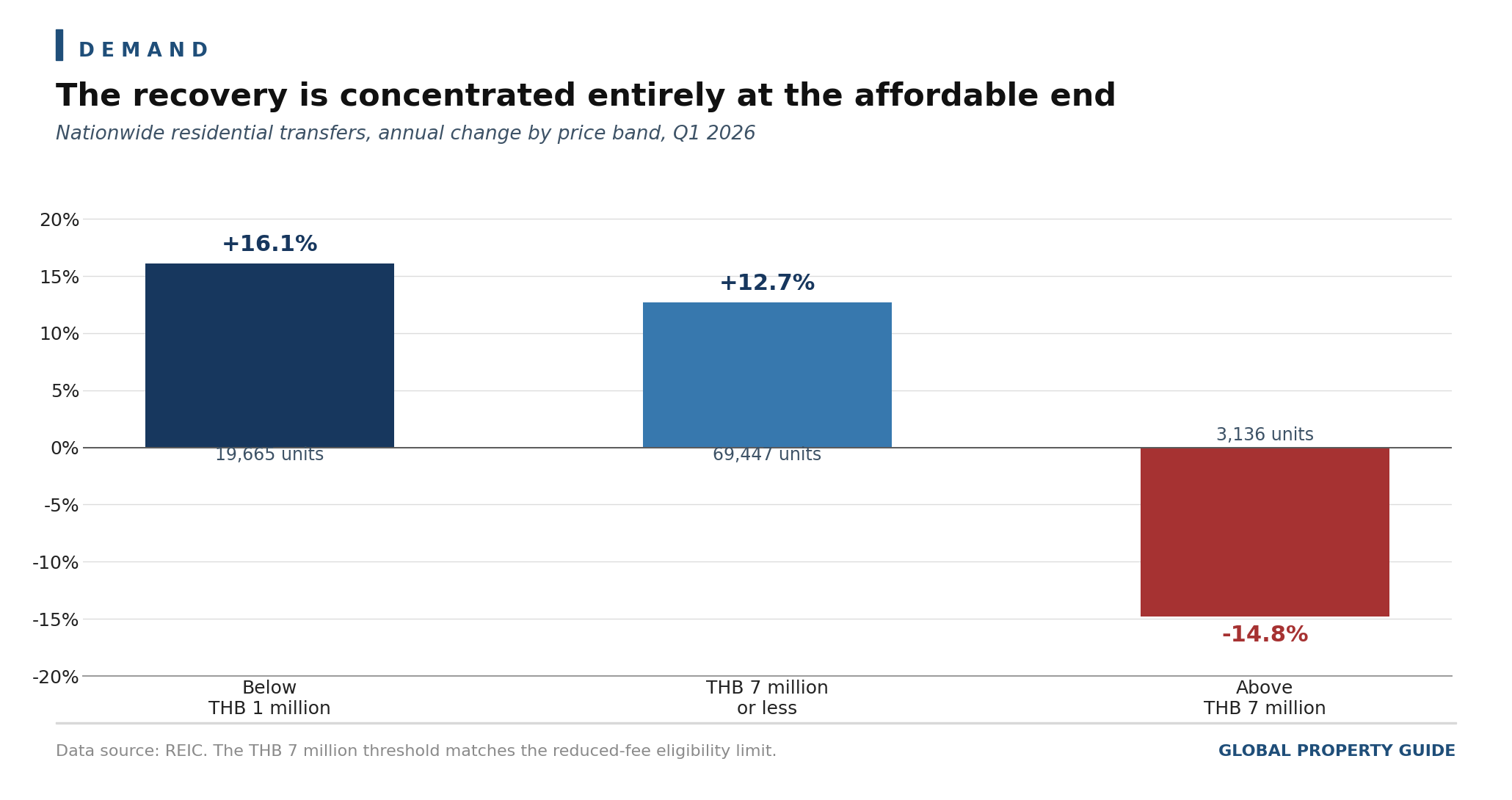
The recovery is almost perfectly bounded by the government's fee-relief threshold. Homes priced at THB 7 million (USD 212,121) or less recorded 69,447 transfers, up 12.7%, while transactions above that level fell 14.8% to 3,136 units. The strongest growth of all came in the cheapest band, with units priced below THB 1 million (USD 30,303), up 16.1% to 19,665 transfers. As REIC's acting director Narongpol Prapanirin put it, the divergence between volume and value growth indicates that most transfers occurred in the lower-priced segment.
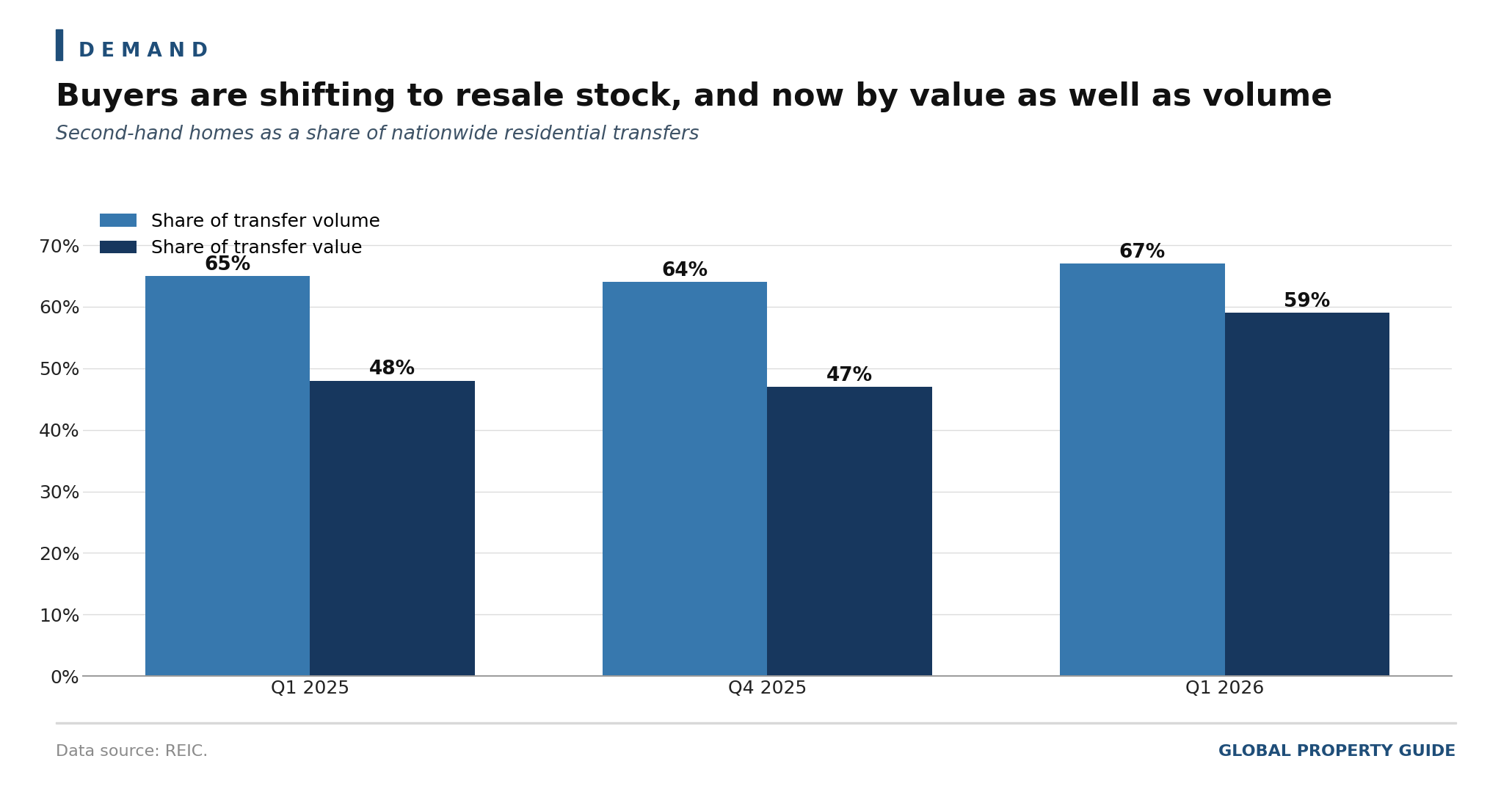
A second shift is underway alongside the first. Second-hand homes accounted for 48,446 transfers worth THB 93.3 billion (USD 2.83 billion) in Q1 2026, or 67% of volume and 59% of value. The volume share has moved up only gradually, from 65% a year earlier, but the value share jumped from 48% to 59% in twelve months. Resale transfers rose 13.8% by volume and 7.7% by value, while new-home transfers grew 6.2% by volume and actually declined 1.1% by value. Buyers are trading down, and increasingly they are trading down into existing stock.
Foreign demand moved in the opposite direction. Condominium ownership transfers to foreign nationals fell 17.3% to 3,241 units in Q1 2026, with value down 17.9% to THB 13.46 billion (USD 408 million) and total usable area down 13.8% to 141,644 square metres. Foreign buyers represented 13.6% of all condominium transfer units and 23.9% of transfer value. REIC attributed the weakness to slower economic conditions at home and abroad, with Chinese purchasers in particular constrained by liquidity problems in their domestic market.
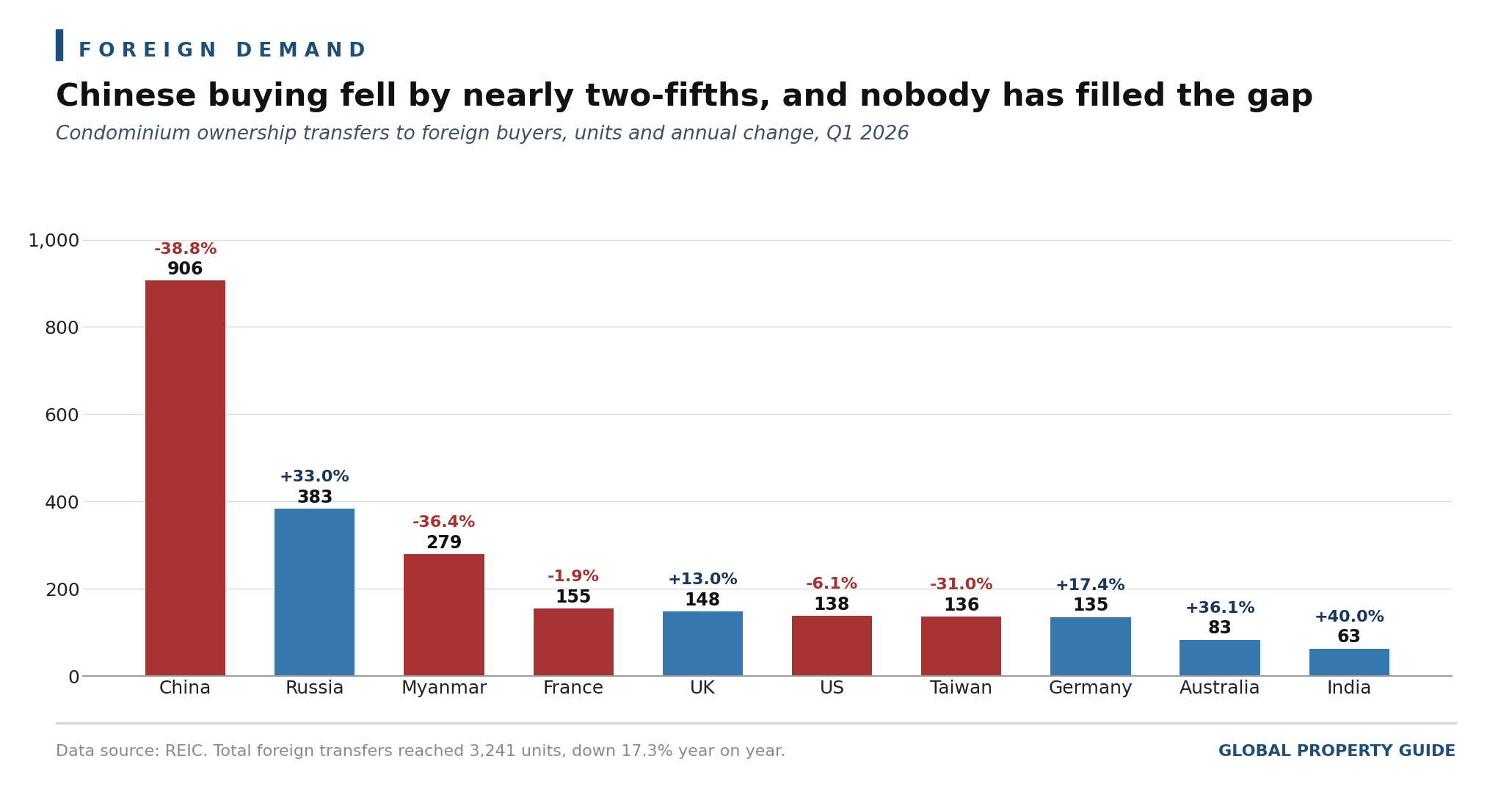
Chinese nationals remained the largest single group but bought 906 units, down 38.8%. No other nationality has come close to absorbing that loss. Russian purchases rose 33.0% to 383 units and Australian purchases 36.1% to 83, but from small bases. Cushman and Wakefield observed that while Myanmar demand has risen modestly and Russian buyers remain active in Phuket and Pattaya, their presence in Bangkok is limited, and interest from Middle Eastern and other international buyers has yet to reach the scale needed to replace previous Chinese volumes.
| Transfers of residential property rights in condominiums to foreign buyers, by nationality: | ||||||
| Nationality of Foreign Buyers | Units transferred, Q1 2026 |
YoY, % | Value, THB million, Q1 2026 |
YoY, % | Avg value per unit, THB m |
Avg area per unit, sqm |
| China | 906 | -38.8% | 3,493 | -42.9% | 3.9 | 39.9 |
| Russia | 383 | 33.0% | 1,665 | 68.7% | 4.3 | 42.1 |
| Myanmar | 279 | -36.4% | 968 | -39.0% | 3.5 | 33.2 |
| France | 155 | -1.9% | 627 | 2.4% | 4.0 | 49.2 |
| UK | 148 | 13.0% | 570 | -23.4% | 3.9 | 49.7 |
| US | Unlock | Unlock | Unlock | Unlock | Unlock | Unlock |
| Taiwan | Unlock | Unlock | Unlock | Unlock | Unlock | Unlock |
| Germany | Unlock | Unlock | Unlock | Unlock | Unlock | Unlock |
| Australia | Unlock | Unlock | Unlock | Unlock | Unlock | Unlock |
| India | Unlock | Unlock | Unlock | Unlock | Unlock | Unlock |
| Others | Unlock | Unlock | Unlock | Unlock | Unlock | Unlock |
| Data Source: REIC. | ||||||
Indian buyers stand out for ticket size rather than volume, with an average of THB 5.6 million (USD 169,697) per unit against a foreign-buyer average of THB 4.2 million (USD 127,273), and an average unit area of 67.8 square metres against 43.7 square metres overall. Chonburi recorded the largest number of foreign condominium transfers, supported by Pattaya, while Bangkok remained the largest market by value.
Looking ahead, REIC still expects the market to contract slightly across 2026 as a whole, with nationwide transfers forecast to fall 1.1% to 312,814 units and value to decline 2.3% to THB 845.24 billion (USD 25.61 billion). The forecast reflects continued pressure on household purchasing power and the risk that higher energy, transport, and construction-material costs feed through. Industry practitioners are cautiously more constructive on the second half: Soonthorn Sathaporn, president of the Housing Business Association, said in July that H2 2026 was likely to perform slightly better than H1, though any recovery would be gradual.
Property Supply Trends
Completions Collapse While Launches and Permits Rebound
Thailand's supply position is best understood as two opposing movements. Completions are collapsing, which is helpful. New permitting and launch activity has turned up sharply, which, over time, is not given the size of the existing overhang.
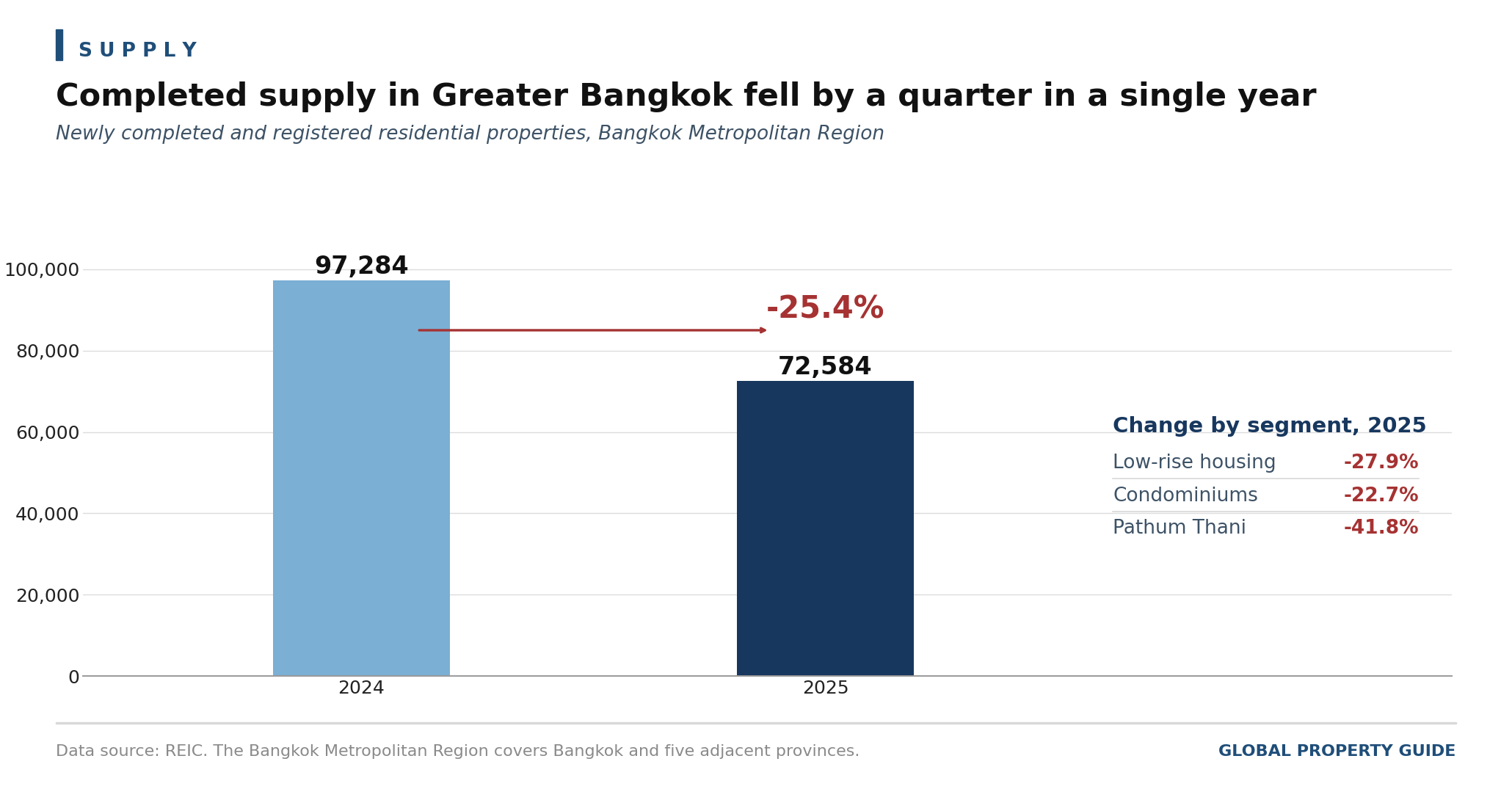
Completed supply fell steeply through 2025. In the Bangkok Metropolitan Region, 72,584 newly completed residential properties were registered during the year, down 25.4% from 97,284 in 2024. Low-rise completions fell 27.9% and condominium completions 22.7%, with declines across all six provinces in the series and the steepest contraction, 41.8%, in Pathum Thani. Bangkok itself accounted for 38,969 completed properties, down 19.5%. The contraction carried into 2026: BOT data show registered completions in the region down 24.0% year on year in the first two months of the year, with apartments and condominiums down 38.3%.
Permitting, by contrast, has rebounded. Data from the National Statistical Office of Thailand show permits issued for 56,342 new residential buildings nationwide in Q1 2026, up 20.0% year on year, with permitted floor area up 13.1% to approximately 7.55 million square metres. The Northeast led with 12,939 buildings, up 38.7%, closely followed by Bangkok and its surrounding provinces at 9,392, up 38.2%.
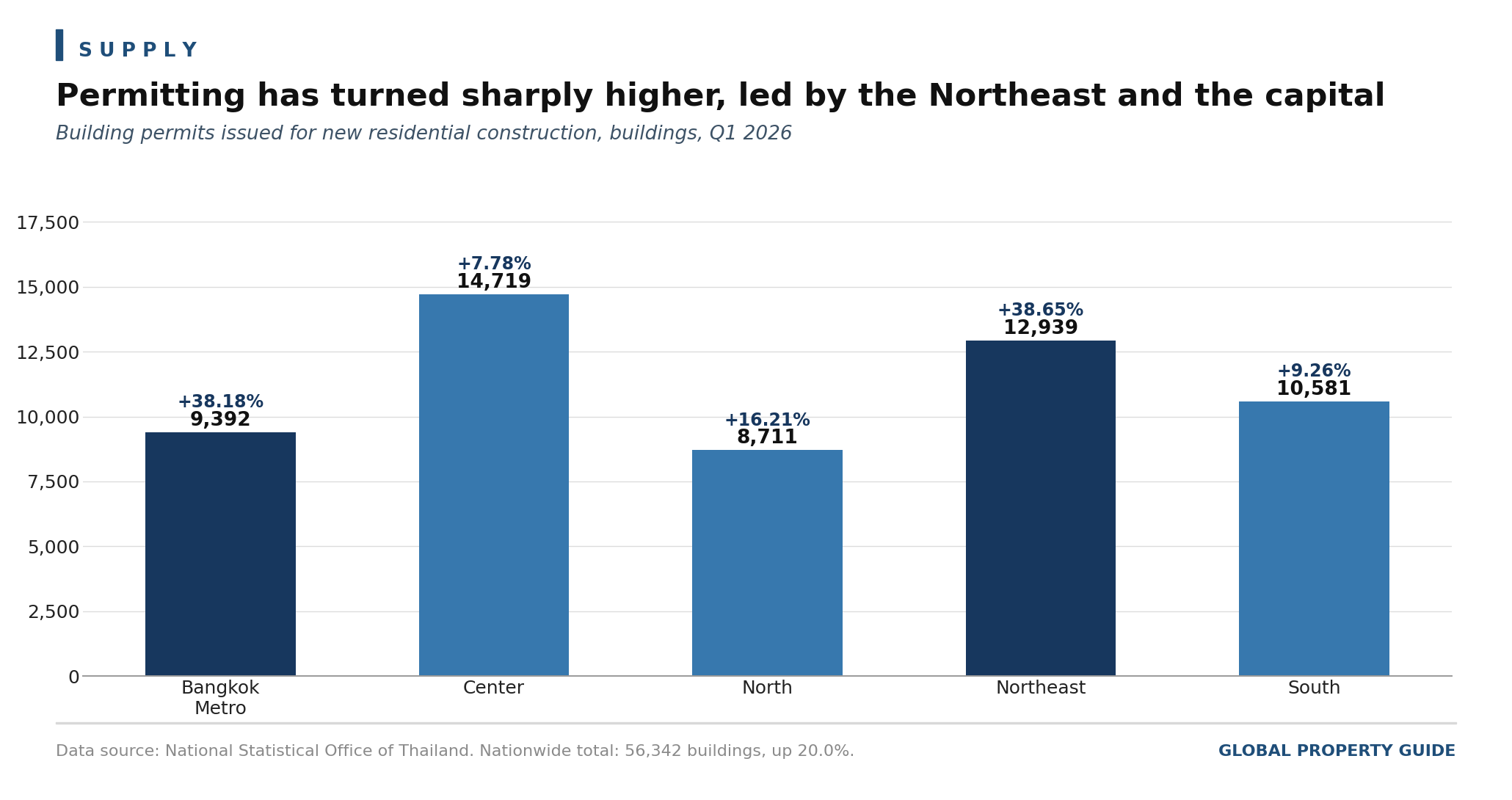
| Building permits issued for new residential construction, by region: | ||
| Region | Building Permits Issued, Q1 2026 |
YoY, % |
| Bangkok Metro | 9,392 | 38.18% |
| Center | 14,719 | 7.78% |
| North | 8,711 | 16.21% |
| Northeast | 12,939 | 38.65% |
| South | 10,581 | 9.26% |
| Data Source: National Statistical Office of Thailand. | ||
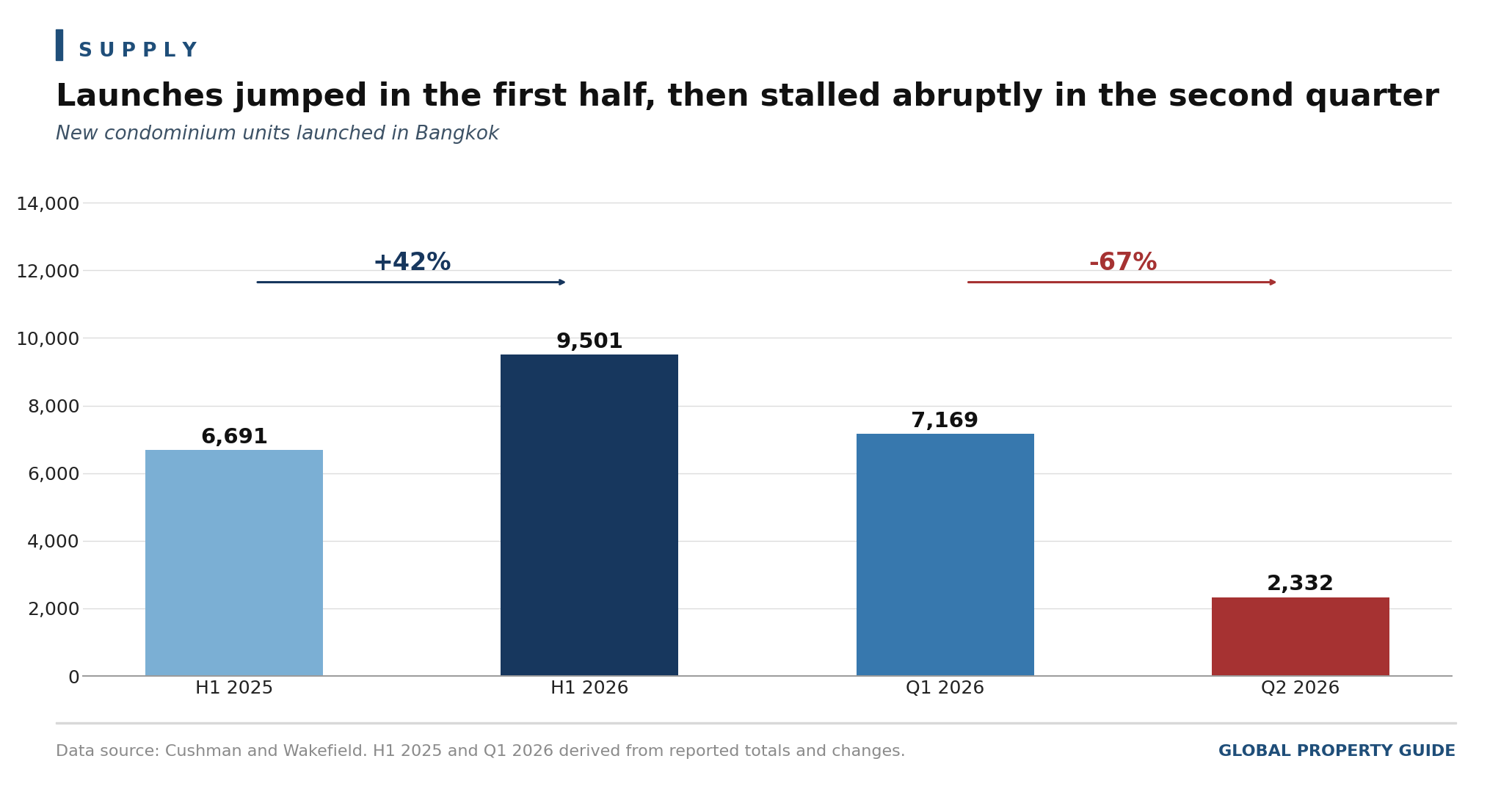
Condominium launches tell a similar story of a rebound that then faltered. Cushman and Wakefield reported approximately 9,501 units launched in Bangkok during H1 2026, up 42% on H1 2025, but only 2,332 of those came in the second quarter, a fall of 67% from the first. Surachet Kongcheep, the firm's head of research and consultancy, expects full-year launches to exceed the initial forecast of around 17,000 units and possibly approach 20,000.
What is being launched matters as much as how much. Around 90% of second-quarter launches were located along the BTS Sukhumvit Line outside the central business district, and the average launch price rose to approximately THB 150,420 (USD 4,558) per square metre, up 78.4% from the previous quarter. The H1 2026 average of about THB 120,360 (USD 3,647) per square metre was the highest first-half figure since 2020. Surachet was explicit that this reflects developers deliberately targeting higher-income buyers rather than any strengthening of demand. Nearly all launches came from listed developers, with non-listed firms contributing just 68 of the 9,501 units, as smaller developers postponed projects while awaiting further government measures.
CBRE's mid-year assessment points the same way: 2,380 units launched in downtown Bangkok in H1 2026, up 207% year on year, and 8,982 in midtown and suburban markets, up 46%, with the luxury and super-luxury segments outperforming and existing premium supply achieving a 93% sales rate. Low-rise launches were essentially flat at 4,584 units against 4,457 a year earlier, around 90% of them from well-established developers, and CBRE noted early signs that the long accumulation of unsold low-rise inventory is beginning to slow.
The overhang remains the central problem. Colliers estimated the cumulative Bangkok condominium supply at 209,954 units against 142,325 sold, implying roughly 67,600 unsold units and six to seven years of absorption if annual new supply stays below 15,000 units. Taking a wider view across all residential types in Bangkok and its surrounding provinces, Prasert Taedullayasatit of the Thai Condominium Association put unsold stock at more than 200,000 units worth over THB 1.3 trillion (USD 39.39 billion). The Real Estate Sales and Marketing Association separately estimated new-home stock at 210,000 units nationwide, requiring four to five years to clear, and second-hand stock at 220,000 to 230,000 units, up from about 120,000 in 2024 as economic pressure pushed more owners to sell.
Rental Market: Rents and Rental Yields
Rent Inflation Stays Low While Yields Improve on Falling Prices
Renting is gaining ground in Thailand, and the reason is straightforward: many households that would prefer to buy cannot obtain a mortgage.
Thailand's rent price index:
The last official measure of tenure remains dated. The 2010 Census conducted by the National Statistical Office estimated homeownership at 78.9%, down from 82.4% in 2000, with 16.5% of residents renting for a fee and 4.3% renting free of charge. The preliminary results of the 2025 Census have not yet reported tenure, but the direction of travel is not in doubt. The Nation Thailand described a clear shift from buying to renting as tighter mortgage rules and high household debt push consumers away from ownership, with younger consumers placing greater value on flexibility and city living. Prachachat Business Newspaper had earlier documented the same phenomenon under the label Generation Rent, noting that young professionals increasingly do not want to own because living costs and housing prices exceed their purchasing power, particularly in well-connected urban locations.
Bangkok's rental demand is further supported by a substantial expatriate population, with nearly 103,000 foreigners registered in the capital province as of June 2026, while Phuket, Pattaya, Koh Samui and Chiang Mai sustain short-term rental demand.
Despite this, measured rent inflation stays very low. The rent component of the consumer price index registered 0.29% year on year in June 2026, according to the Trade Policy and Strategy Office, a fraction of headline inflation. Ample supply, and the same weak incomes that are constraining purchases, are holding rents down across the mass market.
Yields, however, have improved because prices have fallen faster than rents. Global Property Guide research found gross rental yields averaging 6.49% in Q1 2026, up from 6.17% a year earlier. Regional performance varied widely, with Samut Prakan highest at 8.52% and Nonthaburi at 7.14%, against Bangkok at 6.22%, Chon Buri at 5.51%, and Phuket at 5.05%.
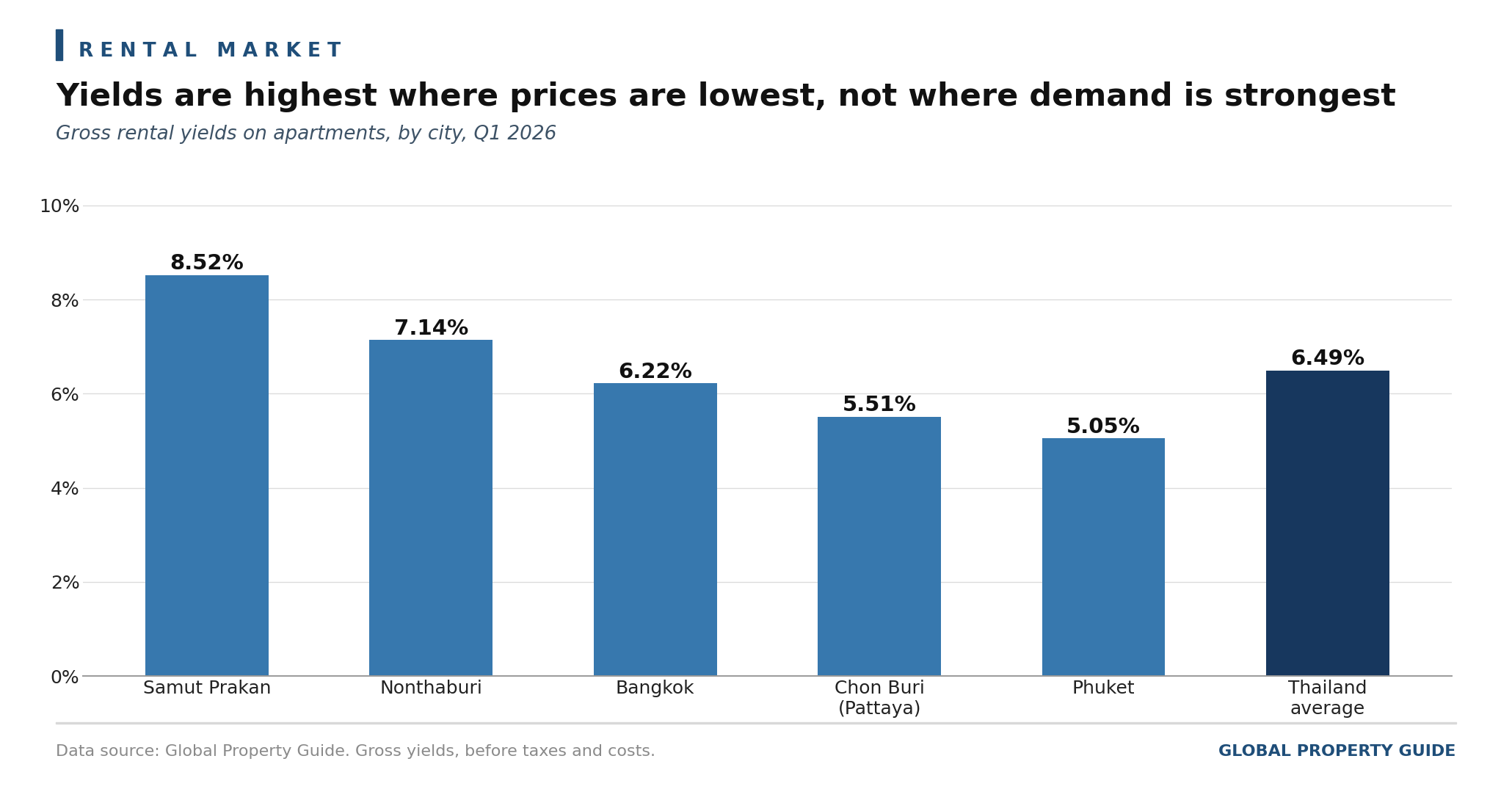
The pattern is worth reading carefully. The highest yields sit in the peripheral provinces where capital values are lowest, and price growth has been weakest, not in the locations with the strongest tenant demand. Investors buying yield in Samut Prakan are being compensated for capital risk, not rewarded for spotting a stronger rental market.
In nominal terms, Global Property Guide research found listed rents in February 2026 averaging USD 220 to 550 a month for studio units, USD 310 to 800 for one-bedroom units, USD 580 to 1,770 for two-bedroom units, and USD 1,930 to 3,500 for three-bedroom units, with the highest levels in the Bangkok and Phuket submarkets.
The prime segment behaves differently from the rest of the market. JLL reported average gross rents for high-end and luxury units in Bangkok at THB 765 (USD 23.18) per square metre in Q1 2026, a 5.1% annual increase, with central-area luxury yields firming to 5.4% as rents rose while capital values fell. JLL expects that momentum to moderate, forecasting rental growth of 2.4% for 2026 as more luxury units complete.
Mortgage Market and Interest Rates
Cheaper Credit, but Access Remains the Binding Constraint
Credit access, not interest rates, is what is holding the Thai housing market back. This distinction matters because policy has done a great deal about the first and very little about the second.
Thailand's mortgage loan interest rates:
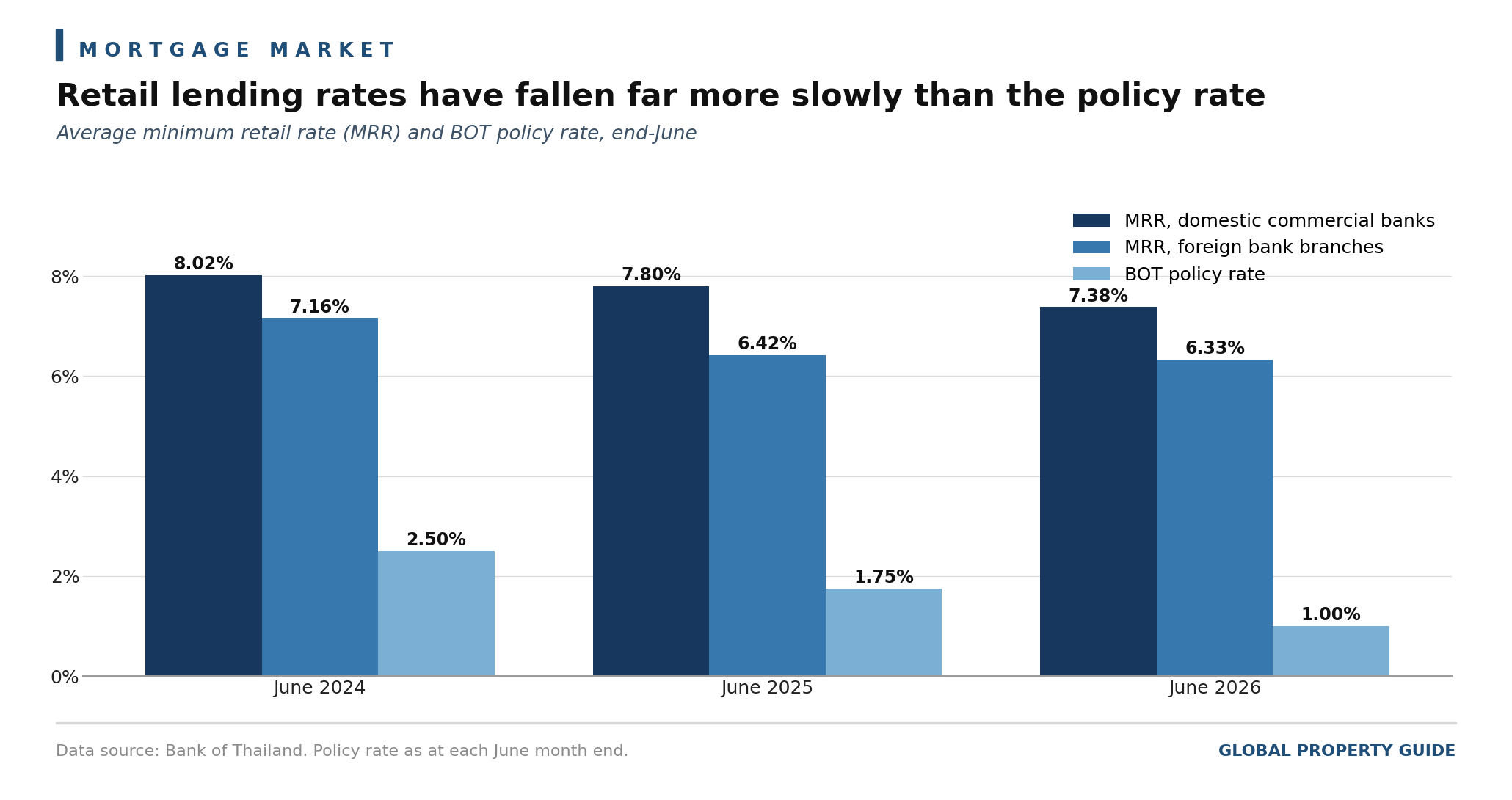
The BOT has cut its policy rate by a cumulative 150 basis points since October 2024, from 2.50% to 1.00%, with the last reduction in February 2026. It has since held at that level. At its meeting on 24 June 2026, the Monetary Policy Committee voted unanimously, seven to nil, to maintain the rate, judging that an accommodative stance combined with targeted financial measures has helped support the recovery while growth remains low and uneven. The committee expects inflation to exceed the target range through the remainder of 2026 before declining in 2027. The next review is scheduled for 26 August 2026.
Retail rates have followed the policy rate only partially. At the end of June 2026, the average minimum retail rate for domestic commercial banks stood at 7.38%, down from 7.80% a year earlier and 8.02% two years earlier. Foreign bank branches averaged 6.33%, against 6.42% and 7.16%, respectively. Against 150 basis points of policy easing over roughly the same window, domestic commercial bank MRRs have fallen by 64 basis points in two years, leaving a spread of more than six percentage points over the policy rate.
| Selected banks Minimum Retail Rate (MRR): | |||
| Bank | June 2026 | June 2025 | June 2024 |
| Domestic Commercial Banks | |||
| Bangkok Bank | 6.500% | 6.900% | 7.050% |
| Krung Thai Bank | 6.845% | 7.295% | 7.570% |
| Kasikornbank | 6.580% | 7.030% | 7.300% |
| Siam Commercial Bank | 6.575% | 7.025% | 7.300% |
| Bank of Ayudhya | 6.670% | 7.120% | 7.400% |
| Domestic State Banks | |||
| Government Housing Bank | Unlock | Unlock | Unlock |
| Government Savings Bank | Unlock | Unlock | Unlock |
| Data Source: DDproperty. | |||
Thai lenders typically offer a discounted fixed rate for the first three years before switching to a floating rate tied to MRR. According to data compiled by DDproperty, as of June 2026, the lowest average rate for the first three years ranged between 2.65% and 3.85% at major commercial banks, and stood at 2.66% at the Government Housing Bank and 2.55% at the Government Savings Bank.
New lending has begun to recover. REIC recorded THB 121.6 billion (USD 3.68 billion) in new mortgage loans to individuals in Q1 2026, an 11.1% increase on the same period of 2025. Outstanding housing loans across the financial system stood at THB 5.17 trillion (USD 156.67 billion) at the end of 2025, up 2.0% over the year, with around 53% held by commercial banks and the remainder by state institutions, including the Government Housing Bank and Government Savings Bank. Measured against the economy, the market has been stable, with the loan-to-GDP ratio estimated at 27.3% in 2025.
The recovery in lending should be read with care. Kasikorn Research Center analysts cited by Bangkok Post warned in June that the rebound was partly driven by a low comparison base, as buyers who had delayed purchases while awaiting government stimulus finally transacted, and that mortgage lending would remain weak through 2026 as persistently high rejection rates weigh on transfers.
Those rejection rates are the binding constraint. A survey by the Housing Business Association found the rejection rate for retail borrowers at about 40% in 2025, with the average through H1 2026 unchanged at about 40%. Pornnarit Chounchaisit, president of the Thai Real Estate Association, described applications being turned down because buyers are assessed as lacking sufficient income for homes at the relevant price levels, even where demand exists. The problem facing the Thai market, on this reading, is not demand but access to credit.
Policy has extended its support rather than expanded it. In May 2026, the BOT extended its relaxed loan-to-value rules, which permit lending of up to 100% of collateral value at all price levels, through to 30 June 2027. At the end of June the Cabinet approved a matching one-year extension of the reduction in transfer registration fees from 2% to 0.01% and mortgage registration fees from 1% to 0.01%, applying to residential properties and mortgages of up to THB 7 million (USD 212,121), also running to 30 June 2027. Both measures lower the cost of transacting. Neither addresses whether a bank will approve the loan in the first place.
Historic Perspective
A Market Now Operating at a Structurally Smaller Scale
Thailand's housing market has not simply had a bad few years. It has shifted to a structurally smaller scale of activity, and the comparison with the pre-pandemic period makes that plain.
Transfer volumes illustrate the shift most directly. Nationwide transfers of new and second-hand homes totalled around 310,000 units in 2025, against close to 400,000 before the COVID-19 pandemic, a reduction of roughly a fifth in the size of the market. REIC's forecast of 312,814 transfers for 2026 implies no return to the earlier level.
New supply has adjusted even more sharply. More than 100,000 new homes were once launched nationwide each year; the figure has now fallen to just over 50,000. In the Bangkok condominium market specifically, Colliers recorded full-year 2025 launches of 16,718 units, against a pre-pandemic norm several times higher. Even Cushman and Wakefield's upgraded 2026 expectation of close to 20,000 units would leave launch volumes at a fraction of the levels that built the current overhang.
The five-year price record shows how uneven the aftermath has been. Between Q1 2021 and Q1 2026, the nationwide index rose 13.53%, but Bangkok and its vicinities managed only 10.61%, while the South gained 20.10%. Set against cumulative consumer price inflation over the same period, the capital has delivered little or no real appreciation, which is a notable outcome for a market that spent the previous decade as the region's condominium development centre.
Mortgage debt has meanwhile grown faster than the housing stock it finances. Outstanding housing loans equalled 27.3% of GDP in 2025, up from 21.5% a decade earlier in 2014. That expansion sits inside a much larger household debt problem: the household debt-to-GDP ratio reached 86.7% at the end of 2025, among the highest in the region, and the NESDC has identified rising household debt amid tighter bank lending as a direct constraint on domestic demand and economic growth.
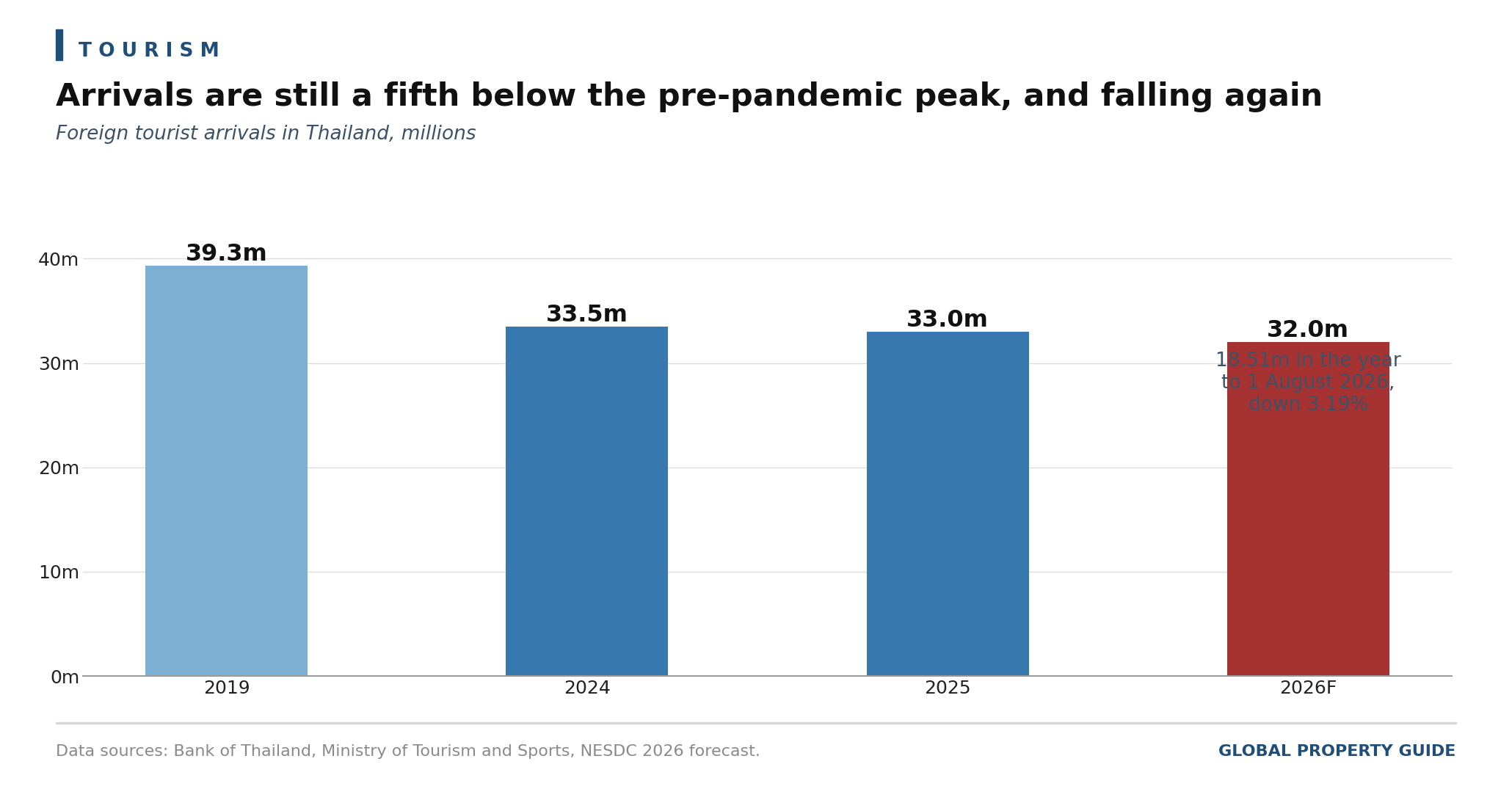
Tourism, which underpins the resort property markets of Phuket, Pattaya, and Koh Samui, has yet to recover its pre-pandemic footing either. Arrivals peaked at 39.3 million in 2019, reached 33.5 million in 2024, fell 7.2% to 33.0 million in 2025, and are forecast by the NESDC at 32 million for 2026, which would leave the sector some 19% below its peak seven years on.
Finally, tenure itself has been drifting. Homeownership fell from 82.4% in 2000 to 78.9% in 2010 on census measures, and the combination of high household debt, a 40% mortgage rejection rate, and the Generation Rent shift documented by Thai media suggests the 2025 Census, when tenure results are published, is likely to confirm a further decline.
Economic and Social Factors
Growth Beats Expectations, but Not for Households
Thailand's economy has outperformed expectations in 2026 without changing the underlying picture for housing, because the growth that has materialised has not reached households.
Real GDP expanded 2.8% year on year in Q1 2026, accelerating from 2.5% in Q4 2025 and comfortably beating the 2.2% median forecast in a Reuters poll, with seasonally adjusted quarterly growth of 0.7%. Total investment grew 9.9%, the fastest in 44 quarters, and exports benefited from the global technology and artificial intelligence cycle. The BOT subsequently upgraded its 2026 growth forecast to 2.3%, easing to 1.8% in 2027, while the NESDC has maintained a range of 1.5% to 2.5%, and the IMF projects 1.9%.
The central bank has nonetheless warned that Thailand is experiencing a K-shaped divergence, in which sectors tied to global investment expand while the domestic base remains fragile and small, and small and medium enterprises face severe credit contraction. For the housing market, which depends on domestic incomes rather than export earnings, it is the weaker arm of that K that matters.
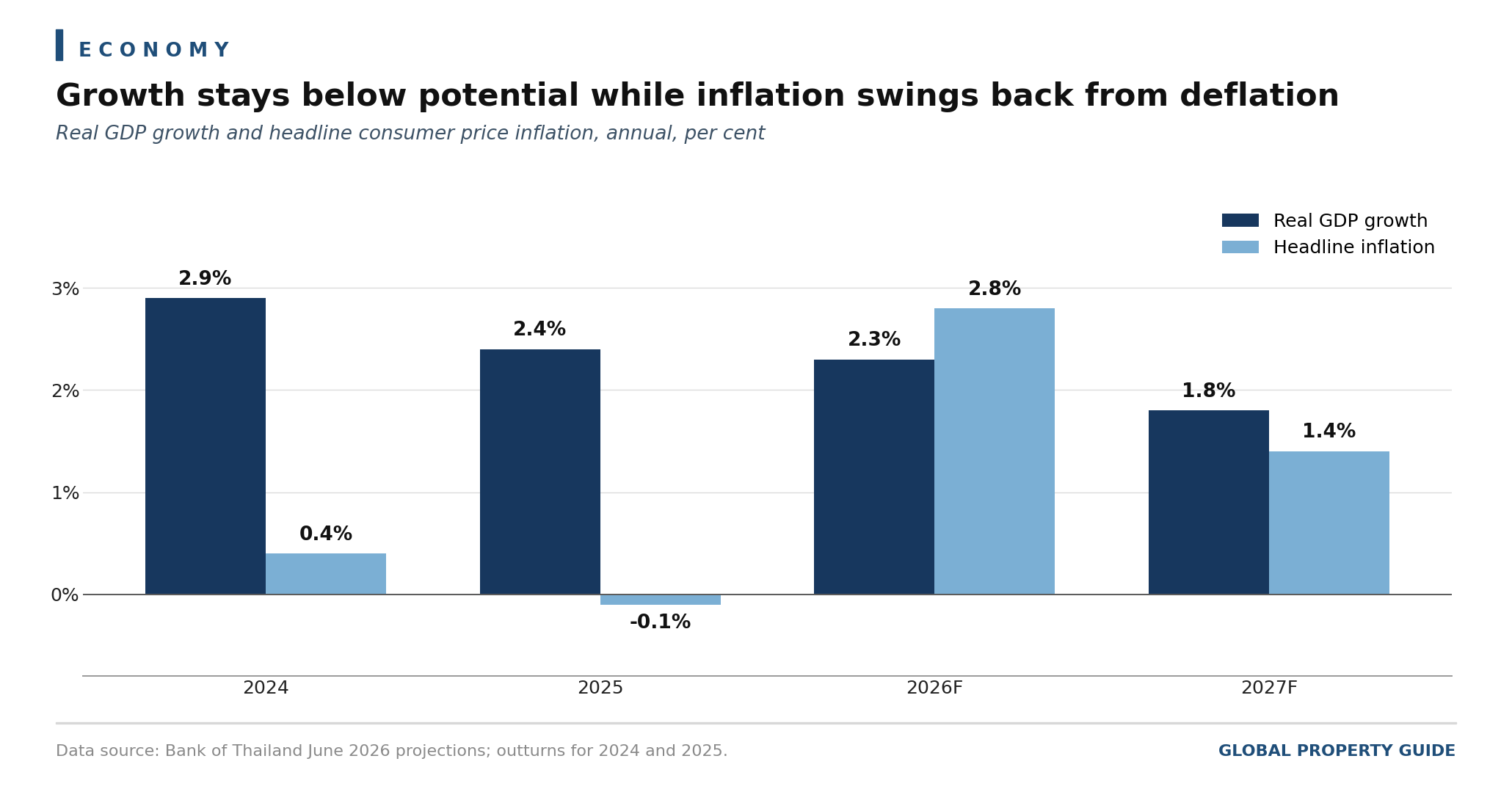
Inflation has swung from deflation to a genuine cost-of-living squeeze. After averaging -0.1% in 2025, consumer prices turned positive in April 2026 under the impact of the Middle East conflict on energy markets, peaked at 2.8% in May, and eased to 2.42% in June and 1.95% in July as oil prices fell. Core inflation accelerated to 1.34% in July. The Trade Policy and Strategy Office maintains a full-year forecast of 1.5% to 2.5%, projecting averages of 2.09% in Q3 and 2.33% in Q4, while the BOT projects 2.8% for 2026 and 1.4% for 2027. For households already carrying heavy debt, the return of inflation erodes the real incomes on which mortgage affordability is assessed.
Tourism remains a drag. Foreign arrivals between 1 January and 1 August 2026 reached 18.51 million, down 3.19% year on year, generating over THB 896 billion (USD 27.15 billion) in revenue. China remained the largest source market, followed by Malaysia, India, Russia, and South Korea. Reduced flight capacity from India and security concerns in the southern provinces have both weighed on volumes, and the NESDC cut its full-year forecast to 32 million from an earlier 35 million.
The labour market has begun to soften from an unusually tight position. Unemployment rose to 0.91% in Q1 2026 from 0.70% in Q4 2025, with the NESDC noting particular difficulty among new graduates entering the workforce. The rate remains very low by international standards, but the headline conceals long-standing structural weaknesses: a shrinking labour force as the population ages, a large informal sector with limited social protection, and the resulting inequality that feeds household indebtedness.
Public finances are under pressure but not yet strained. Public debt stood at THB 12.68 trillion at the end of March 2026, equivalent to 66.38% of GDP, with Finance Minister Ekniti Nitithanprapas projecting 68% during 2026 against a ceiling of 70%. Both major rating agencies have flagged concern: Moody's changed its outlook on Thailand's Baa1 rating from stable to negative in early 2025, and Fitch revised its outlook on the BBB+ rating to negative in September 2025.
Politically, the picture is more settled than it has been for some time. The February 2026 snap election returned a decisive victory for the conservative Bhumjaithai Party, and the government under Prime Minister Anutin Charnvirakul has indicated its intention to serve a full four-year term with a focus on debt relief and reviving economic activity. In May 2026, it approved a THB 400 billion (USD 12.12 billion) emergency borrowing decree, upheld by the Constitutional Court in July, funding a consumer subsidy scheme and green energy investment. The associated co-payment programme has supported consumer confidence, which the TPSO reported at 51.1 in July, a second consecutive month in positive territory.
For housing, the implication is that policy support will continue but is likely to remain focused on transaction costs and demand-side subsidies. Unless bank lending standards loosen or household incomes rise materially, the market will keep clearing at the affordable end while its expensive inventory sits unsold.
Sources
- National Statistical Office of Thailand (NSO)
- 2025 Population and Housing Census, Preliminary Results: https://www.nso.go.th/
- 2010 Population and Housing Census: https://www.nso.go.th/
- Construction Site Data Processing, Q1 2026 (TH): https://www.nso.go.th/
- Bank of Thailand (BOT)
- Residential Property Price Index and Land Price Index: https://app.bot.or.th/
- Property Indicators: https://app.bot.or.th/
- Policy Interest Rate: https://www.bot.or.th/
- Monetary Policy Committee's Decision 3/2026: https://www.bot.or.th/
- Monetary Policy Committee's Decision 2/2026: https://www.bot.or.th/
- Daily Interest Rates of Commercial Banks: https://www.bot.or.th/
- Labor Force Survey: https://app.bot.or.th/
- Tourism Indicators: https://app.bot.or.th/
- Economic Outlook: https://www.bot.or.th/
- The Central Bank Has Extended the LTV Measure for Another Year (TH): https://www.bot.or.th/
- Real Estate Information Center (REIC)
- Housing Market Situation in Q1 2026 (TH): https://www.reic.or.th/
- The Bangkok and Metropolitan Area Housing Market Situation in Q4 2025 and Outlook for 2026 (TH): https://www.reic.or.th/
- Highlight Data Q4 2025 (TH): https://www.reic.or.th/
- REIC Indicates That the Housing Market in the First Quarter of 2026 Was Boosted (TH): https://reic.or.th/
- Report on the Transfer of Condominium Ownership to Foreigners, Q1 2026 (TH): https://www.reic.or.th/
- Trade Policy and Strategy Office (TPSO)
- Consumer Price Index and Inflation (TH): https://index.tpso.go.th/
- National Economic and Social Development Council (NESDC)
- Thai Economic Performance in Q1 2026 and Outlook for 2026: https://www.nationthailand.com/
- Bureau of Registration Administration
- Statistics for Executives (TH): https://www.bora.dopa.go.th/
- International Monetary Fund (IMF)
- World Economic Outlook Update, July 2026: https://www.imf.org/
- Country Overview: Thailand: https://www.imf.org/
- OECD
- OECD Economic Outlook, Volume 2026 Issue 1, Thailand: https://www.oecd.org/
- Federal Reserve Economic Data (FRED)
- Thai Baht to US Dollar Spot Exchange Rate: https://fred.stlouisfed.org/
- Global Property Guide
- Gross Rental Yields in Thailand: https://www.globalpropertyguide.com/
- JLL
- Asia Pacific Residential Market Dynamics: https://www.jll.com/
- Bangkok Residential Market Dynamics: https://www.jll.com/
- CBRE
- 2026 Thailand Real Estate Market Outlook: https://www.cbre.co.th/
- CBRE Thailand Mid-Year Outlook 2026: https://www.retalkasia.com/
- Cushman and Wakefield
- Thailand Real Estate Market Update 2026: https://www.cushmanwakefield.com/
- Colliers
- Bangkok Condominium Market Q4 2025: https://www.colliers.com/
- SCB EIC
- Thailand's Household Debt-to-GDP Ratio Rose to 86.7% at End-2025: https://www.scbeic.com/
- DDproperty
- Home Loan Interest Rates from All Banks (TH): https://www.ddproperty.com/
- Moody's Ratings
- Moody's Ratings Changes Thailand's Outlook to Negative from Stable, Affirms Baa1 Ratings: https://ratings.moodys.com/
- Fitch Ratings
- Fitch Revises Thailand's Outlook to Negative, Affirms at BBB+: https://www.fitchratings.com/
- Reuters
- Thailand PM Anutin Consolidates Power with Dominating Election Win: https://www.reuters.com/
- Thai PM Says New Government Will Complete Full Term: https://www.reuters.com/
- Thai Court Rules Government's USD 12 Billion Borrowing Decree Lawful: https://www.reuters.com/
- Bangkok Post
- Thai Q1 GDP Grows 2.8% Year on Year, Above Forecast: https://www.bangkokpost.com/
- Residential Transfers Up 11.2% in Q1: https://www.bangkokpost.com/
- Resale Homes Take Larger Market Share: https://www.bangkokpost.com/
- Bangkok Condo Market Remains Resilient in Q1: https://www.bangkokpost.com/
- Home Loans to Stay Weak in 2026 on Flat Confidence: https://www.bangkokpost.com/
- Property Stimulus Extended a Year: https://www.bangkokpost.com/
- Thailand's July Headline CPI Rises 1.95% Year on Year: https://www.bangkokpost.com/
- Office Says Prepared Food Prices Expected to Increase: https://www.bangkokpost.com/
- Thailand's Foreign Tourist Arrivals Down 3.2% on Year So Far in 2026: https://www.bangkokpost.com/
- The Nation Thailand
- Thai Sellers Cut Prices on New and Second-Hand Homes Amid Tight Lending: https://www.nationthailand.com/
- Thailand Homebuyers Turn to Renting as Loan Hurdles Rise: https://www.nationthailand.com/
- MPC Raises Thai Growth Forecast on AI and Export Boost: https://www.nationthailand.com/
- NESDC Maintains 2026 Thai Growth Forecast Amid High Uncertainty: https://www.nationthailand.com/
- Bank of Thailand Extends LTV Easing to June 30, 2027: https://www.nationthailand.com/
- Thailand Extends 0.01% Property Fee Cut in One-Year Lifeline for Homebuyers: https://www.nationthailand.com/
- Prachachat Business Newspaper
- Gen Rent, Customers Rejecting Loans, Real Estate Trends for New Generation Consumers (TH): https://www.prachachat.net/